In 1956, a Mercury buyer could get a 312-cubic-inch V8 and a rubber floor mat in the same car. No carpet, no bumper guards, no radio unless he paid for one, and often not even a heater. The car was called the Medalist, and it was Mercury’s attempt to sell its size and power to buyers who usually stopped at the Ford dealer.
It did not last. Mercury dropped the name after one season, brought it back for 1958, and dropped it again. But for a buyer who cared more about the engine than the trim, it was about as straightforward as a Mercury ever got.
Mercury Heads Downmarket
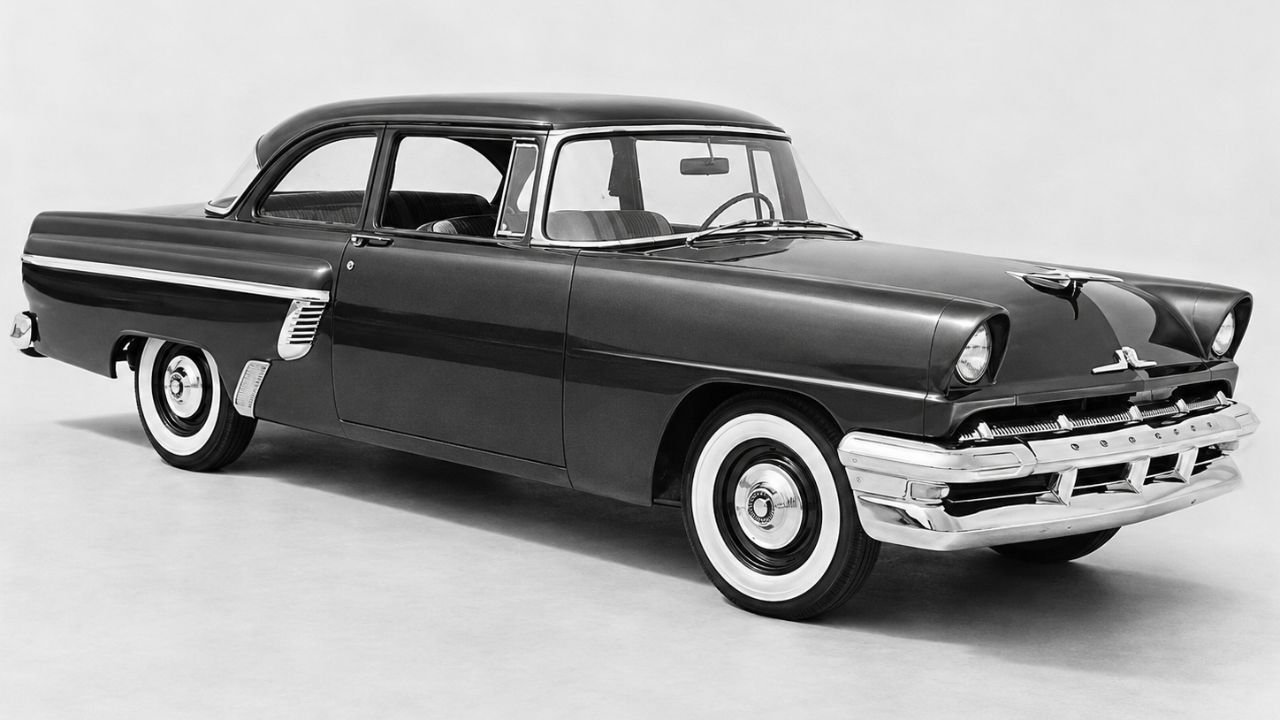
The timing looked odd. For 1955, Mercury had just moved upmarket with the new Montclair. Then, in September 1955, it introduced the 1956 Medalist as its new entry-level car, below the Custom, Monterey and Montclair. Wikipedia places it in the same market segment as the Ford Customline.
Indie Auto calls 1956 an odd transition year for Mercury, because the brand was moving in two directions at once: up with the new four-door hardtops, down with the Medalist. A brochure listed three series and 12 models, while production records show four series and 18.
The price was the point. The Medalist two-door sedan listed at $2,254 (1956 dollars). Indie Auto lines that up against the competition: a V8 Dodge Coronet at $2,267, a Pontiac Chieftain 860 at $2,236 and an Oldsmobile Eighty-Eight at $2,166. Mac’s Motor City Garage notes that the Medalist cost about $100 less than a Mercury Custom and about $60 more than a Ford Fairlane hardtop.
The Same V8 as Every Other Mercury
What the Medalist did not skimp on was the drivetrain. Every 1956 Mercury rode the same 119-inch wheelbase and used the 312-cubic-inch Y-block V8 with a four-barrel carburetor.
With the standard three-speed manual and 8.0:1 compression, the Medalist was rated at 210 horsepower. Over-Drive Magazine lists the outputs for the rest of the range: 215 horsepower with the base automatic, 225 horsepower with 9.0:1 compression as an option on all lines, and a dual-carburetor “Maximum Duty” version with 260 horsepower on special order with a manual transmission. Mac’s Motor City Garage simply gives 225 horsepower for the Medalist with Merc-O-Matic.
How many Medalist buyers paid extra for the automatic is not known. Mac’s Motor City Garage says more than 90 percent of all 1956 Mercury buyers chose Merc-O-Matic, but it does not break that figure down by series.
What Was Missing
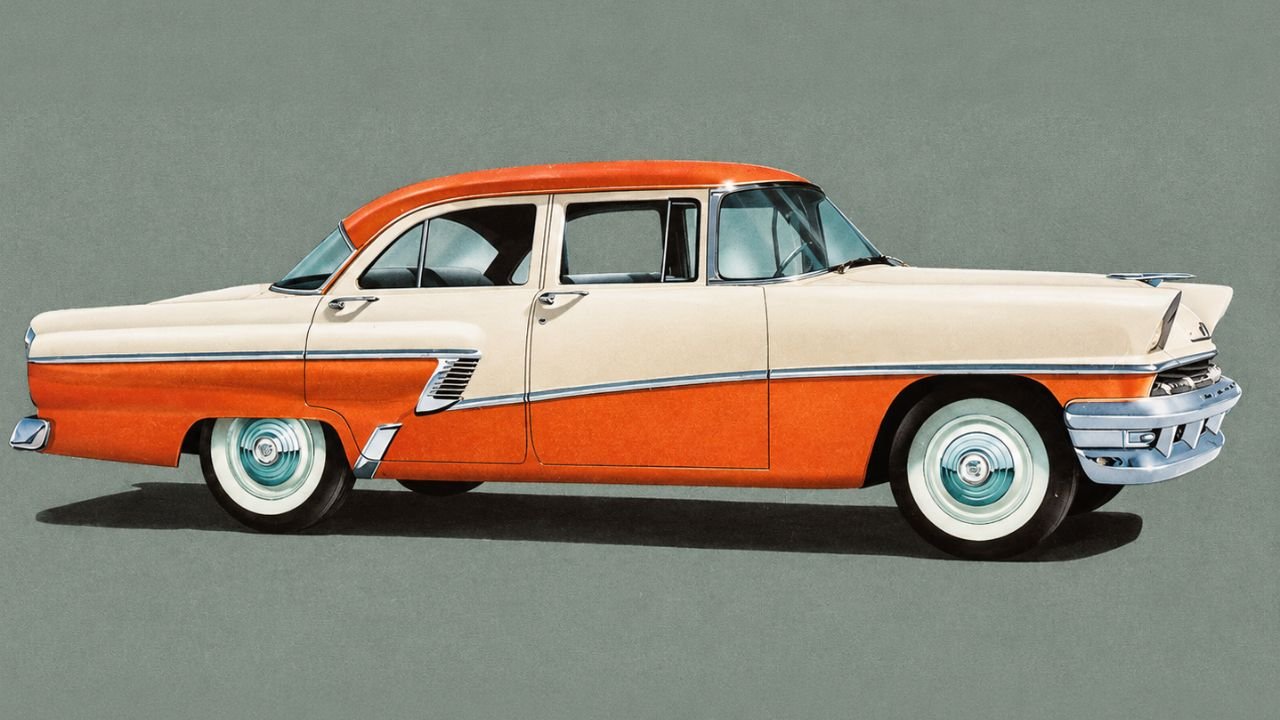
The savings showed on the outside. The Medalist had no front bumper guards. Old Cars Weekly notes that the first cars also lacked the stainless side spears on the front fenders and doors and the chrome exhaust ports in the rear bumper. A single tailpipe exited below the bumper instead. Dog-dish hubcaps completed the look.
Inside, buyers got textured vinyl upholstery and rubber floor mats instead of carpeting. Chrome window surrounds and stainless trim on the rear quarter panels were standard. Almost everything else was on the options list, according to Wikipedia: heater and defroster, the “Travel-Tuner” signal-seeking radio, a padded dash, seat belts, power steering, power brakes, power windows, a power front seat and whitewall tires.
Buyers could at least choose bright colors. Wikipedia lists 31 traditional two-tone combinations and 28 “Flo-tone” schemes, in which the roof and lower body shared one color.
From One Body to Four
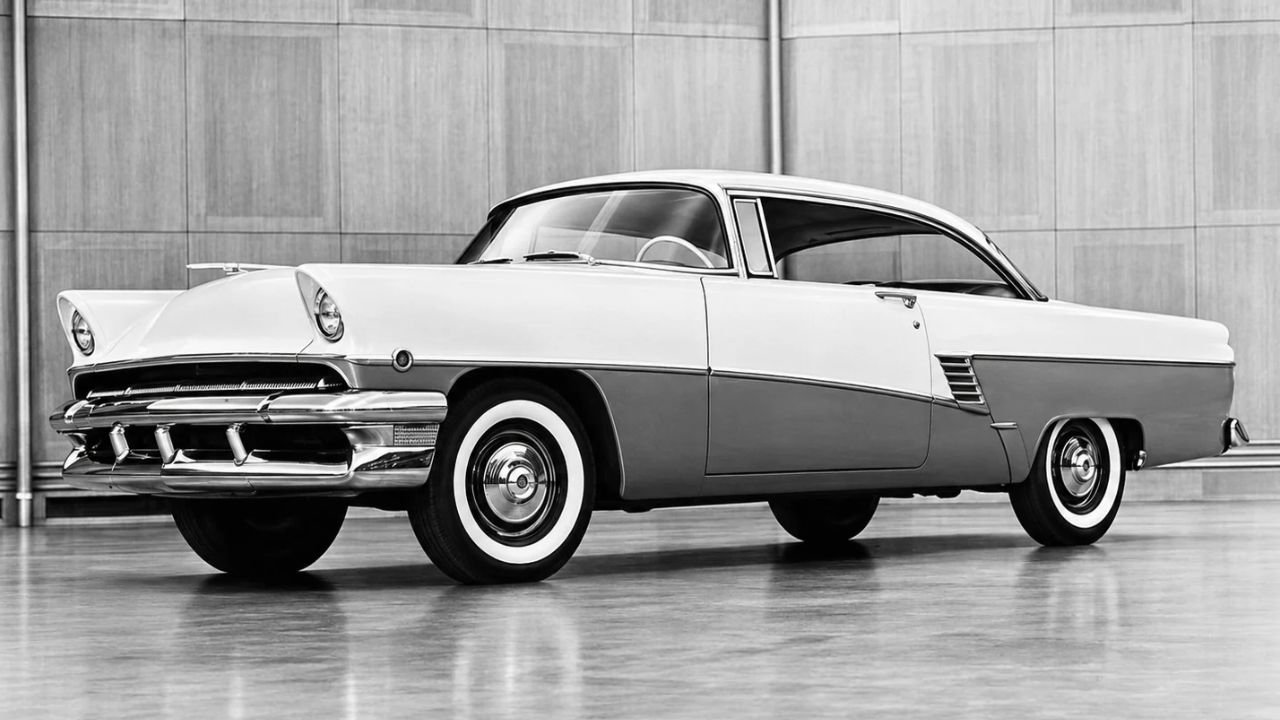
The Medalist started as a two-door sedan only. During the year, Mercury added a four-door sedan, a two-door hardtop and a four-door hardtop. Over-Drive Magazine notes that Mercury marketed its new four-door hardtops as the “Phaeton” across all lines, a name normally used for open cars. Mac’s Motor City Garage adds that a slash of stainless trim was added to the front fenders and doors, and that the hardtops raised the price to $2,389 for the two-door and $2,458 for the Phaeton (1956 dollars).
How many Medalists Mercury built depends on the source. Wikipedia gives 20,582. Over-Drive Magazine lists exactly that number for the two-door sedan alone, plus 11,892 two-door hardtops, 6,685 four-door hardtops and 6,653 four-door sedans. That adds up to 45,812 cars for the series.
Mercury as a whole held steady. Indie Auto reports output of about 328,000 cars for 1956, even though production of all premium-priced cars fell by almost 19 percent, and Mercury’s share of that segment rose to 13.6 percent.
Why It Struggled
The problem was the gap to the next car up. Indie Auto quotes the historian Richard Langworth, who argued that the Medalist sold poorly because it was not priced far enough below the Custom to make up for its cheaper look. With only about $100 between the two, that argument is easy to follow.
Dealers had their own reasons to push buyers up. Mac’s Motor City Garage notes that salesmen disliked stripped base models because of their thin margins, but advertised them heavily anyway to bring shoppers into the showroom.
For 1957, Mercury moved up again. The Medalist and the Custom were both dropped, and the Monterey became the base model. Its two-door sedan listed at $2,576 (1957 dollars), placing it against Buick’s entry-level Special.
The 1958 Comeback
The name returned for one more year. In 1958, the Medalist came back as the entry-level Mercury, this time as a two-door or four-door sedan on a 122-inch wheelbase. According to Wikipedia, it was actually better equipped than the 1956 version, with cloth-and-vinyl upholstery, full carpeting and an electric clock as standard. Mercury built 18,732 of them, at an average list price of $2,582 (1958 dollars). After that year, the name disappeared for good.
One Medalist’s Second Life
Old Cars Weekly has preserved the story of one 1956 Medalist. In November 1957, a young buyer named Roger King found a black two-door Medalist on the floor of Ruby Chevrolet in Chicago and paid $1,300 plus sales tax. It showed 13,000 miles, although an old repair receipt later suggested the real figure was around 40,000.
King did what young owners did. He removed the vertical bars under the upper grille bar, which gave the car a look his friends called “hungry,” added dual exhausts with glasspacks, fender skirts and a tachometer, and fitted three two-barrel Stromberg 97 carburetors and a 1957 Thunderbird E-code camshaft and distributor. The plain base Mercury had become a hot rod.
What a Medalist Brings Today
The Medalist remains rare and affordable. Classic.com records a 1956 Medalist that sold in Greensboro, North Carolina, for $20,000 in February 2025, and lists other cars offered between about $19,000 and $50,000 in 2024, asking prices rather than results. For a car that was meant to be the cheapest Mercury, that is a respectable place to end up.