The Edsel is remembered as the car nobody wanted. That is only half the story. When Ford decided to build it, nearly everyone in Detroit wanted exactly this kind of car. The mid-priced market was booming, Buick was selling more cars than ever, and Ford had no direct answer.
The problem was the calendar. Ford approved the project in the spring of 1955. The car reached showrooms in September 1957. In those two and a half years, the market it was built for changed almost completely.
A Plan Built for a Boom
The idea was older than the car. According to the Edsel timeline kept by the enthusiast site Edsel.com, a new car program went to Ford’s stylists for long-range planning on July 7, 1954. In early 1955, a planning group presented it to Ford’s top executives. Dean’s Garage describes a plan put forward on February 7, 1955, by Jack Reith, a protégé of Ford Division chief Lewis Crusoe. Its budget was $250 million, and it called for separate Lincoln and Mercury divisions plus a brand-new division between Ford and Mercury.
On April 15, 1955, Ford’s Executive Committee approved a new medium-priced line and a separate division modeled on Buick. Three days later, the Special Products Division was set up to build it. The project’s code name was simple: the E-car.
The logic was easy to follow. General Motors could move a buyer up from Chevrolet to Pontiac, Oldsmobile, Buick and Cadillac. Ford’s ladder was much shorter. The E-car was meant to take a bigger share of the medium-priced market away from GM and Chrysler, and to give Ford owners a reason to stay in the family when they traded up.
Six Thousand Names and One Family Name
Finding a name took longer than expected. The ad agency Foote, Cone & Belding reportedly produced more than 6,000 candidates. Ford also asked the poet Marianne Moore for ideas. On December 8, 1955, she sent in her last suggestion: “Utopian Turtletop.”
In the end, the choice fell on a family name. Henry Ford II opposed naming the car after his late father, Edsel Ford. According to Wikipedia, Ernest Breech made the decision at a board meeting chaired in Henry II’s absence. Ford announced the name on November 19, 1956, and the Special Products Division became the Edsel Division, with Richard E. Krafve as general manager.
Four Series, Two Bodies, One Grille
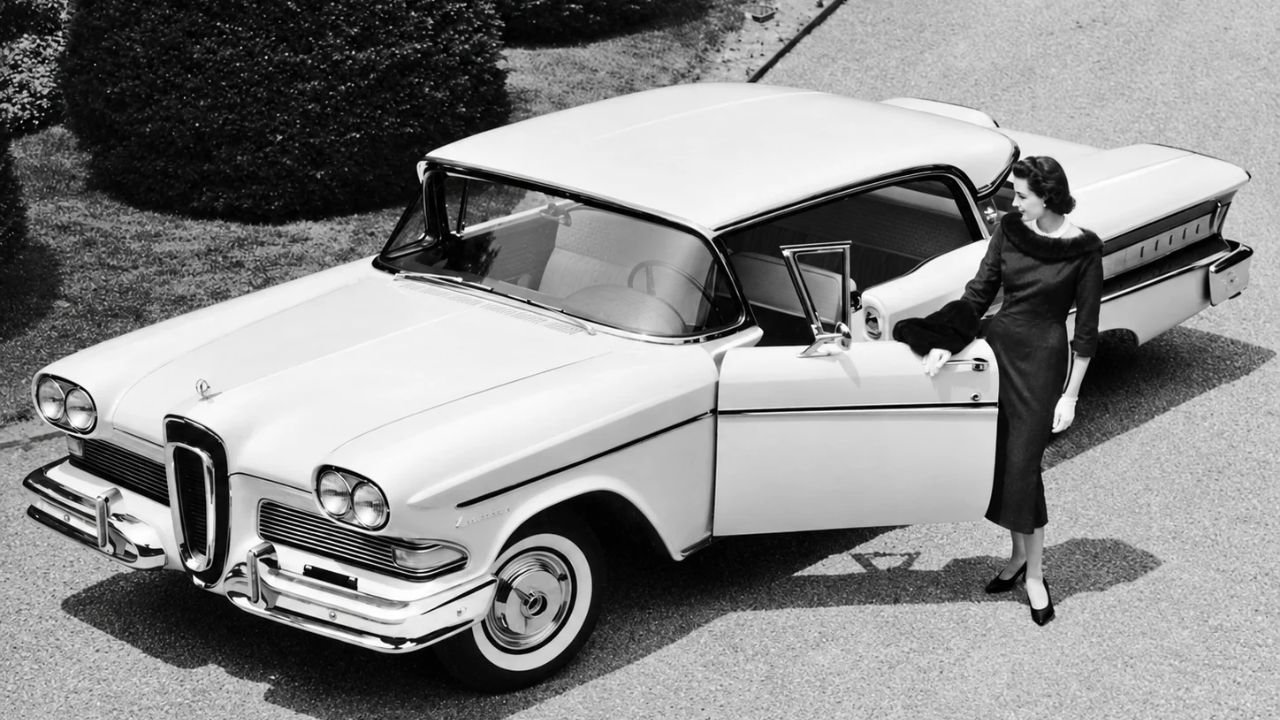
Ford did not give the Edsel a body of its own. The Ranger and Pacer used Ford Fairlane bodies on a 118-inch wheelbase. The Corsair and the top-line Citation used Mercury bodies on a 124-inch wheelbase. The Roundup, Villager and Bermuda wagons came from Ford’s 116-inch wagon platform. Prices ran from $2,484 to $3,766 (1958 dollars).
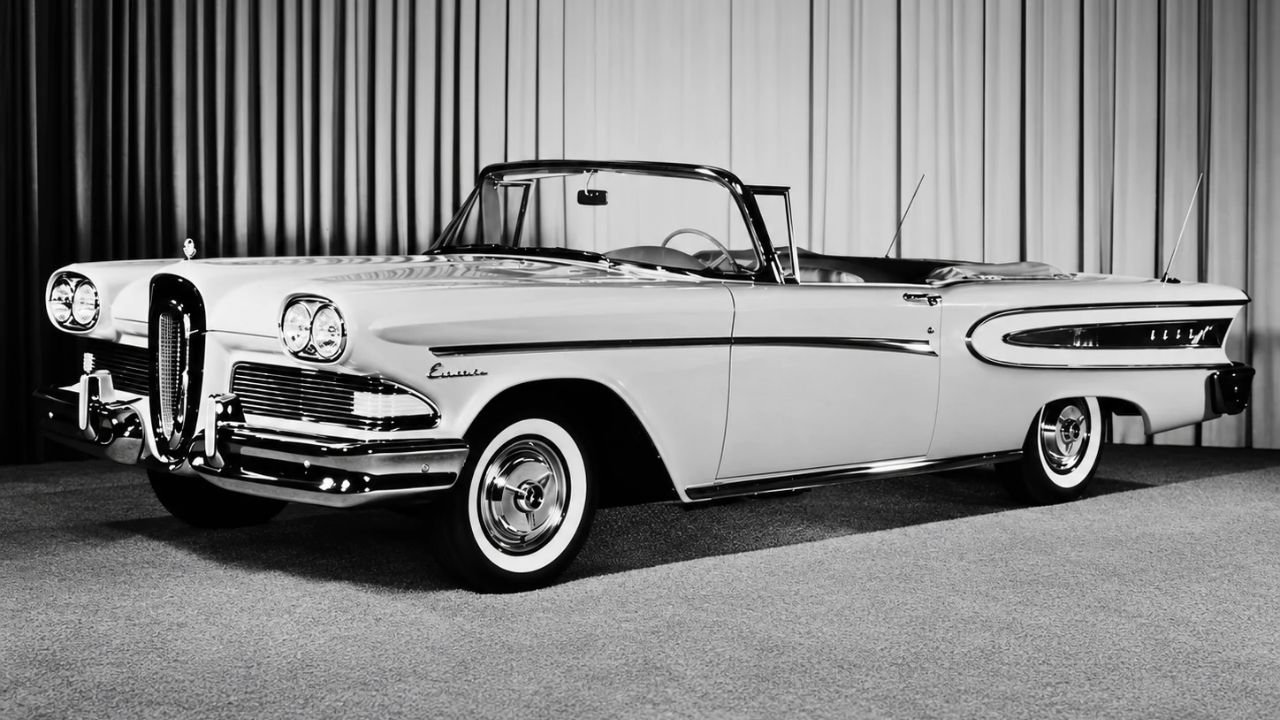
What set it apart was the front. Chief designer Roy Brown had proposed a slender central grille. According to Wikipedia, engineering objections and pressure from Breech, who wanted something taller and wider, turned it into the vertical “horse collar” that became the car’s signature and, for many buyers, its biggest problem.
The equipment list was ambitious. The Edsel offered a rolling-dome speedometer, self-adjusting brakes, a warning light for a preset speed and Teletouch: push-buttons for the automatic transmission in the hub of the steering wheel.
The Citation: Mercury Size, Edsel Muscle
The Citation was the flagship, and it was serious. Under the hood sat the 410-cubic-inch E-475 V8, part of Ford’s MEL engine family, with a four-barrel carburetor and 10.5:1 compression. It was rated at 345 horsepower at 4,600 rpm. The engine name came from its torque: 475 lb-ft at 2,900 rpm.
A three-speed automatic with Teletouch controls was standard, along with a padded dash, a deep-dish steering wheel and a gold-anodized aluminum cove panel on the side. Air conditioning, power steering, power brakes and power windows were on the options list. The car was 218.9 inches long and weighed between about 4,135 and 4,311 pounds, depending on body style.
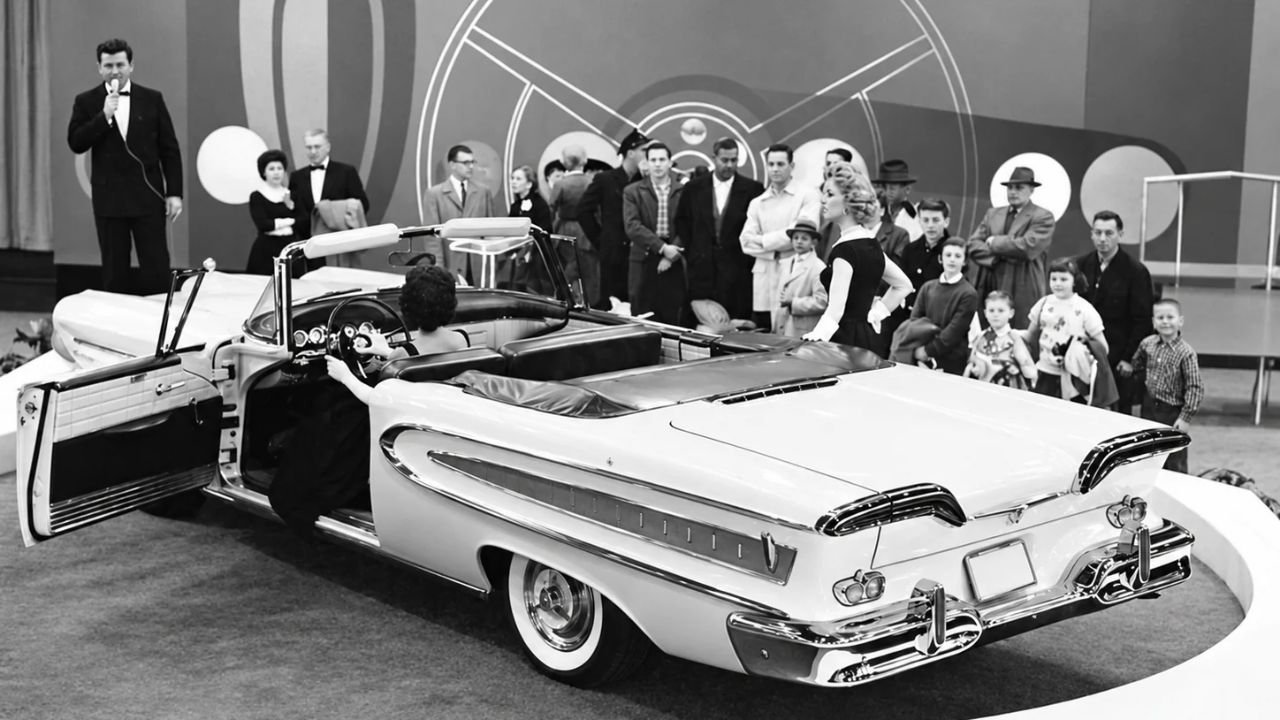
Three body styles were offered: a two-door hardtop at $3,498, a four-door hardtop and a convertible at $3,765 (1958 dollars). Production totaled 8,577 according to Conceptcarz, or 8,574 according to Wikipedia. The four-door hardtop was the most common at 5,112. The convertible was the rarest, with 930 built.
The Citation lasted exactly one model year. For 1959, Edsel moved its whole range onto Ford-based bodies, and the big Mercury-sized Edsel disappeared.
E-Day and the Morning After
Ford launched the Edsel on September 4, 1957, which it called E-Day, after a long teaser campaign. A month later, on October 13, Ford put “The Edsel Show” on television with Bing Crosby and Frank Sinatra. The Audrain Automotive Museum notes that the car drew more showroom traffic on E-Day than any car before it, and Hagerty reports that Edsel set a record for deliveries of a new medium-priced car at its introduction. Ford had signed up 1,187 Edsel dealers.
Krafve had promised a lot. In January 1957, he told the press the Edsel would sell 200,000 cars in its first year, according to Hagerty and Ate Up With Motor. The 1958 model year ended with 63,110 cars sold in the United States, plus 4,935 in Canada. That was less than a third of the target.
Why It Arrived Too Late
The recession that began in 1957 hit exactly the market the Edsel was built for. Ate Up With Motor notes that sales of most mid-priced cars dropped sharply, some by more than 30 percent. Mercury’s own volume fell from about 286,000 cars in the 1957 model year to about 153,000 in 1958. The boom that had justified the Edsel in 1955 was gone by the time the car arrived.
Ford’s own decisions made things worse. Edsels were built on the same lines as Fords and Mercurys, which caused parts confusion and assembly errors. Ate Up With Motor reports that some early cars reached dealers in unsaleable condition. Teletouch proved unreliable and was dropped after 1958. The pricing confused buyers too: the cheapest Edsel was close to the top Ford, while the top Edsel overlapped with Mercury.
The organization fell apart quickly. On January 14, 1958, barely four months after E-Day, the Edsel Division was folded into a combined Mercury-Edsel-Lincoln division. Krafve left Ford about a year after the launch.
The End
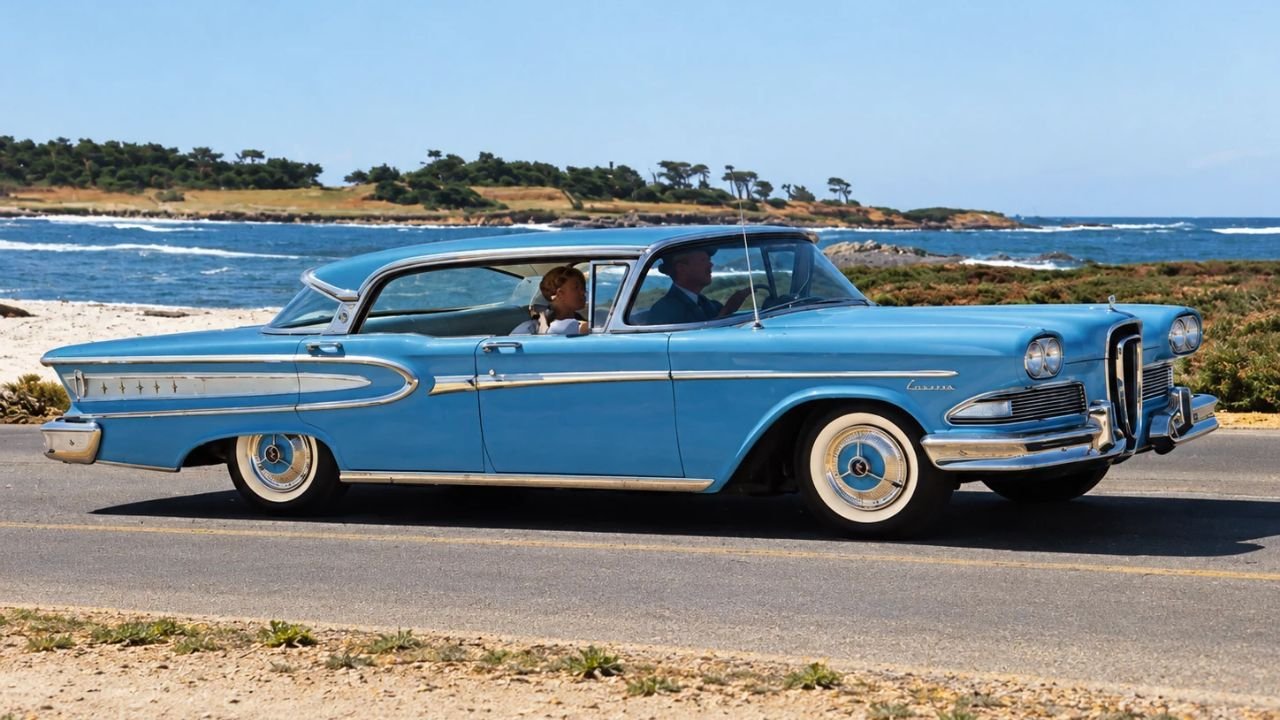
The Edsel survived two more model years. Sales for 1959 reached 44,891 in the United States. Only 2,846 of the 1960 models were built. On November 19, 1959, Ford announced the end of the program.
How much it cost is still argued over. Wikipedia gives losses of more than $250 million in one place and $350 million in another. The Audrain Automotive Museum puts development spending at about $400 million. Total production also varies by source: Wikipedia counts 118,287 cars including Canadian assembly, while Hagerty gives 110,847.
A Flop Worth Six Figures
The car nobody wanted is wanted now. The Audrain Automotive Museum estimates that fewer than 6,000 Edsels survive. At RM Sotheby’s Hershey auction in 2025, a 1958 Citation convertible in Frost White with turquoise scallops sold for $110,000. It had been restored in 1994, carried factory air conditioning and power seat, steering, brakes and windows, and had won an AACA National Senior Award in 2000.
Hagerty has profiled an unrestored 1958 Citation that its second owner drove only to the mailbox and back for 25 years. When it was featured, it showed about 5,900 miles.
The Edsel was not a bad idea. It was a 1955 idea, carefully planned and expensively executed, and it went on sale in a 1958 market. That gap is what turned it into the most famous flop in American automotive history.