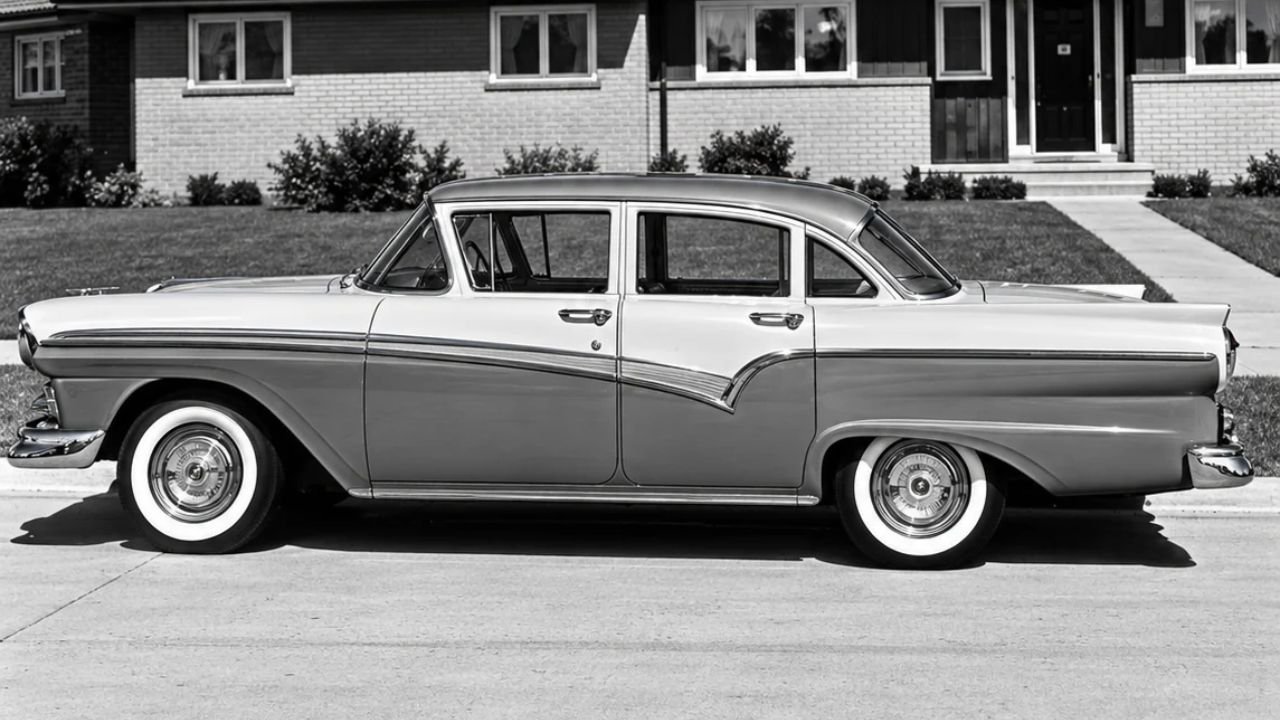
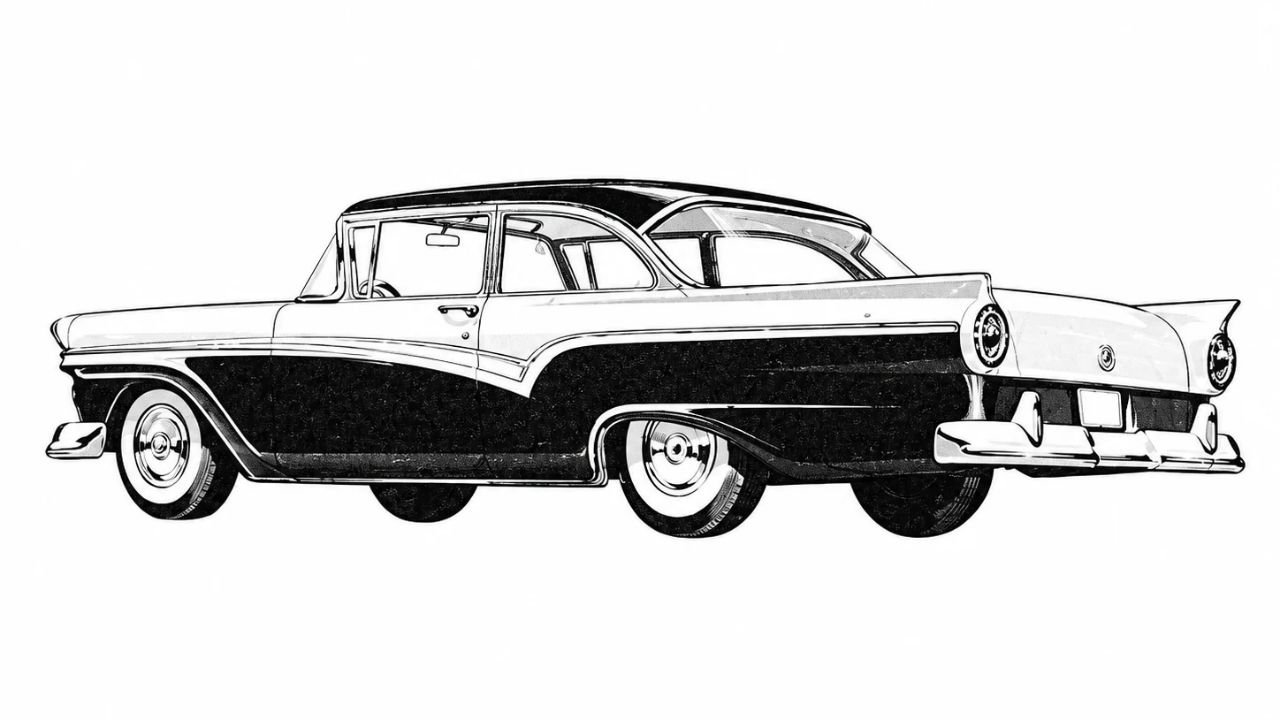
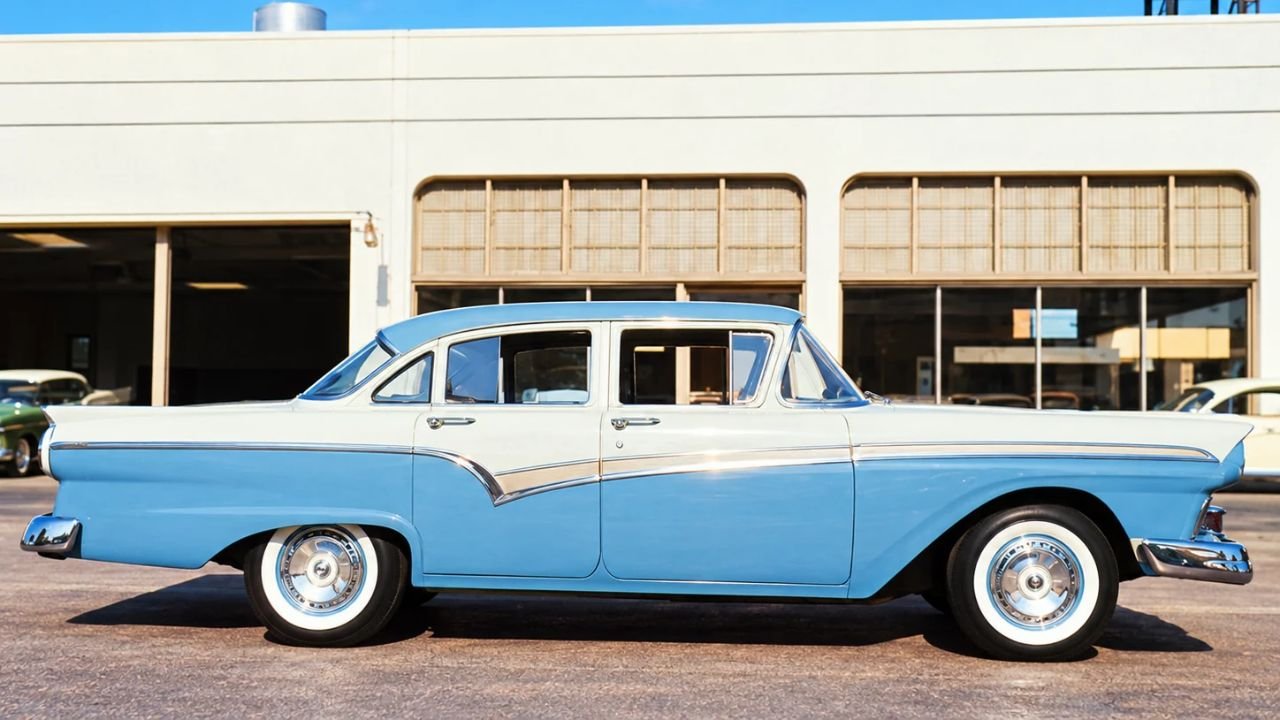
Look at a 1957 Ford Custom 300 today and you see a family sedan. Two doors or four, a bench seat, armrests and a pair of sun visors. It was not the Fairlane 500, not the Skyliner with its folding steel roof, not the car on the brochure cover.
It was, however, one of the cars that did something no Ford had managed in more than twenty years. In 1957, Ford outsold Chevrolet. And on paper, at least, this sensible sedan could be ordered with the same supercharged V8 Ford advertised as its most powerful passenger car engine of the year.
A New Kind of Ford
Ford’s slogan for the year was “a new kind of Ford for ‘57,” and for once the advertising was close to the truth. The sheet metal was all new. So was the frame. Mac’s Motor City Garage notes that Ford adopted a semi-perimeter frame, known inside the company as the “cowbelly” because its side rails bowed outward around the passenger compartment. The design had first appeared on the 1956 Continental Mark II. It let the floor sit lower, and Ford dropped the wheels from 15 to 14 inches to bring the whole car down further.
The ball-joint front suspension and the brakes were revised, and Ford introduced a deep-offset hypoid rear axle. The result was longer, lower and wider than the 1956 Ford, with a single headlight on each side and modest tail fins at the back.
Ford split the lineup in two. The Custom and the Custom 300 rode a 116-inch wheelbase. The Fairlane and Fairlane 500 got a longer 118-inch chassis and fancier trim. The new Ranchero car-pickup was built on the short chassis as well.
What the 300 Bought You
The Custom 300 was the better-equipped of the two short-wheelbase lines. According to Conceptcarz, a Custom 300 two-door sedan listed at $2,100 and a four-door at $2,160, with about $100 more for a V8 (1957 dollars). The plain Custom started at $1,990 for the two-door and $1,890 for the business coupe.
For roughly $110, the 300 badge added chrome window moldings, two sun visors instead of one, armrests on every door and a chrome horn ring. One thing it could not get was Ford-Aire, the $156 optional air suspension. Wikipedia lists it as available on every series except the Custom 300.
Buyers did not seem to mind. Conceptcarz puts Custom 300 production at 160,360 two-door sedans and 194,677 four-door sedans, about 355,000 cars in total. Barn Finds also cites roughly 160,000 two-doors. The four-door figure comes from Conceptcarz alone.
From Six Cylinders to a Supercharger
Under the hood, the range was wide. The base engine was the 223-cubic-inch overhead-valve six with a one-barrel Holley and 144 horsepower at 4,200 rpm. The entry-level V8 was the 272-cubic-inch Y-block with a two-barrel, rated at 190 horsepower at 4,500 rpm. Above that came the 292 Thunderbird V8 at 212 horsepower and the 312 at 245.
Then things got serious. Ford offered the 312 with two four-barrel carburetors, the E-code, at 270 horsepower, and a 285-horsepower racing version with a hotter cam intended for NASCAR competition. Wikipedia notes that the E-code was available on all body types.
At the top sat the F-code. It used a McCulloch-Paxton centrifugal supercharger on the 312 and was rated at 300 horsepower. RM Sotheby’s calls it the most powerful engine Ford put in a passenger car in 1957. Most of these superchargers went into Thunderbirds, but Ford advertised the option as available in any series. Cars so equipped wore “Police Interceptor” lettering on the glove box.
How many Custom 300s actually left the factory with an F-code is not documented in the sources we found. What is clear is that the option existed on paper for Ford’s plainest sedans. That made a sleeper possible right off the dealer’s order form.
The Year Ford Beat Chevy
The sales result is what most people remember about 1957. For the model year, Ford outsold Chevrolet for the first time since 1935, according to Wikipedia. Mac’s Motor City Garage gives the totals as 1,522,406 Fords against 1,515,117 Chevrolets, a gap of about 7,300 cars.
Chevrolet fans have argued about it ever since, because the outcome depends on how the cars are counted. Wikipedia’s 1957 Chevrolet article lists two reasons Ford came out ahead: the Ford’s longer, lower and wider redesign, and buyers’ distrust of the new tubeless tires on the Chevrolet.
The Custom 300 was a big part of that story. With about 355,000 cars, it accounted for roughly one in four Fords by those figures, while the flashier Fairlane 500 and the Skyliner took the attention.
What They Are Worth Now
The Custom 300 never became a collector darling in the way a Fairlane 500 or a Thunderbird did, and that shows in the numbers. Hagerty’s valuation tool lists a 1957 Custom 300 two-door sedan with the 272 V8 at $16,300, without saying which condition that figure represents.
Asking prices can run much higher. In April 2024, Barn Finds featured a two-tone Custom 300 Tudor listed on Craigslist in Sherman, Texas, for $39,500. The seller described the 312 under the hood as an E-code, but the car had only one four-barrel carburetor. The VIN pointed to a 272 V8 originally installed at Long Beach, and the seller admitted the engine was not original. The car also had aftermarket air conditioning and front disc brakes. The condition claims came from the seller.
That case shows what to check on any 1957 Ford. The first letter of the VIN gives the original engine code. On RM Sotheby’s F-code Fairlane 500, sold for $60,500 at Hershey in 2014, the leading “F” in the chassis number was the proof. Many cars today wear engines they were never built with, and a Custom 300 with a real E-code or F-code would be a very different car from one that only claims to be.
The Ford People Actually Drove
The Skyliner made headlines, the Thunderbird made posters, and the Fairlane 500 made the brochure. The Custom 300 made up the numbers that let Ford claim a win over Chevrolet. It was longer and lower than the Ford it replaced, cheap enough to be the family car, and capable, if the buyer checked the right box, of being far quicker than it looked.