For more than two decades, a Buick meant a straight eight. Long hood, long crankshaft, smooth and unhurried. Then came 1954, and that tradition ended in a single model year. Every Buick on the showroom floor, from the cheapest Special to the Roadmaster, now had an overhead-valve V8 and a new body, longer, lower and wider than before. Buick’s advertising called it “the beautiful buy.”
It was more than a slogan. The 1954 line brought back a famous name, carried the most exclusive Buick of its day into its last season, and set the stage for an even bigger 1955.
The Straight Eight Bows Out
The V8 had arrived a year earlier. For 1953, Buick introduced its 322-cubic-inch overhead-valve engine with a 4.0-inch bore and a 3.2-inch stroke. Buick called it the Fireball V8. Hot rodders soon called it something else. Its small valves had long stems that looked like nails, and the Nailhead name stuck.
In 1953, though, the cheapest Buicks still used the old 263-cubic-inch straight eight. For 1954, Buick replaced it with a smaller V8 of its own: 264 cubic inches, a 3.625-inch bore and the same 3.2-inch stroke as its big brother. With a manual transmission and 7.2:1 compression, the Special’s engine made 143 horsepower. Order Dynaflow and the compression went up to 8.1:1 and output to 150 horsepower.
Above it, the 322 came in two stages. The Super got a two-barrel carburetor, 177 horsepower with the manual and 182 with Dynaflow. The Century, Roadmaster and Skylark got the four-barrel version, worth 195 horsepower with a manual and 200 with Dynaflow.
A Lineup Built on Two Bodies
GM restyled its premium divisions for 1954, and Buick split its range across two body families. The Special and the Century rode the smaller B-body on a 122-inch wheelbase. The Super and the Roadmaster moved to the C-body shared with Cadillac and the Oldsmobile 98, with a 127-inch wheelbase. For the Roadmaster, that meant up to 5.5 inches more wheelbase than in 1953 and more than nine inches of extra length.
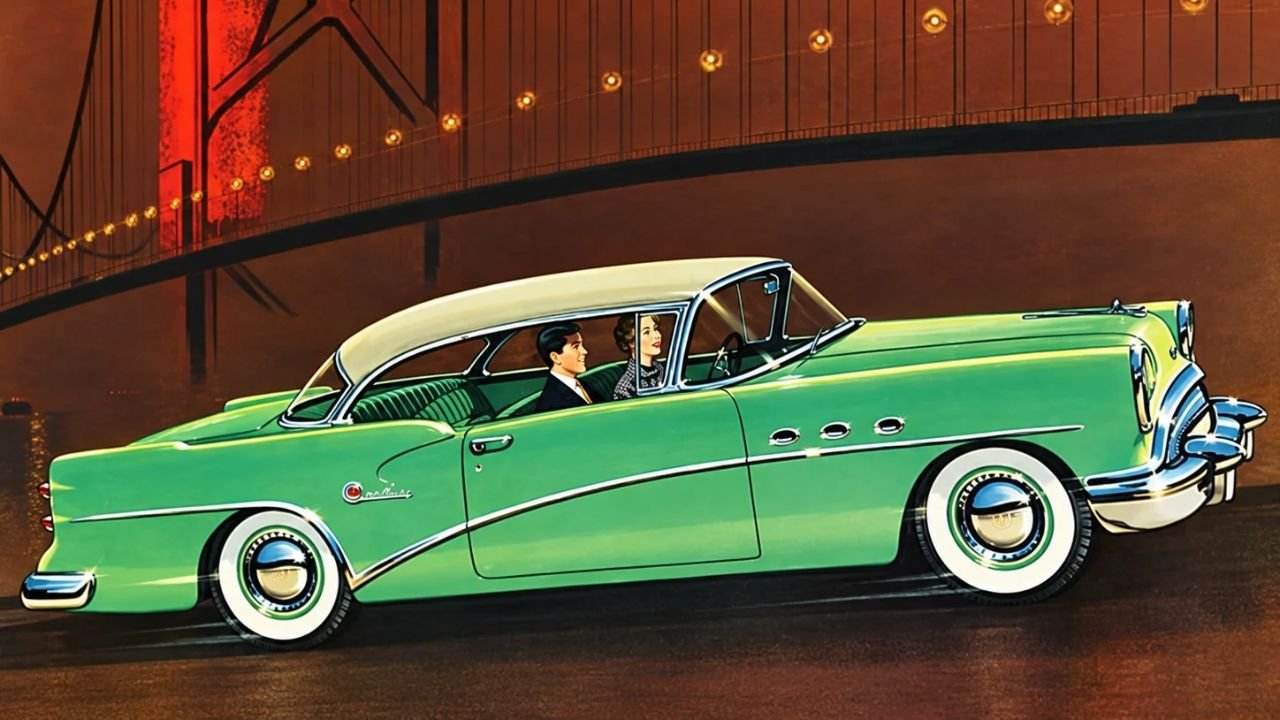
The look came from the Buick studio, which Mac’s Motor City Garage credits to studio chief Ned Nickles. Nickles was the man who had invented the ventiports, the chrome portholes in the front fenders, by fitting them to his own 1948 Roadmaster. Buick general manager Harlow Curtice put them into production for 1949, and they were still there in 1954, along with the wide toothed grille and the sweeping side spear. The new Panoramic windshield, with near-vertical side pillars, was the change everyone noticed.
At the top of the regular lineup, the Roadmaster ran from about $3,270 for the four-door Riviera sedan to $3,521 for the convertible (1954 dollars). Dynaflow, power steering and power brakes were standard. Buyers who wanted more could order Frigidaire air conditioning on sedans and hardtops.
The Banker’s Hot Rod Returns
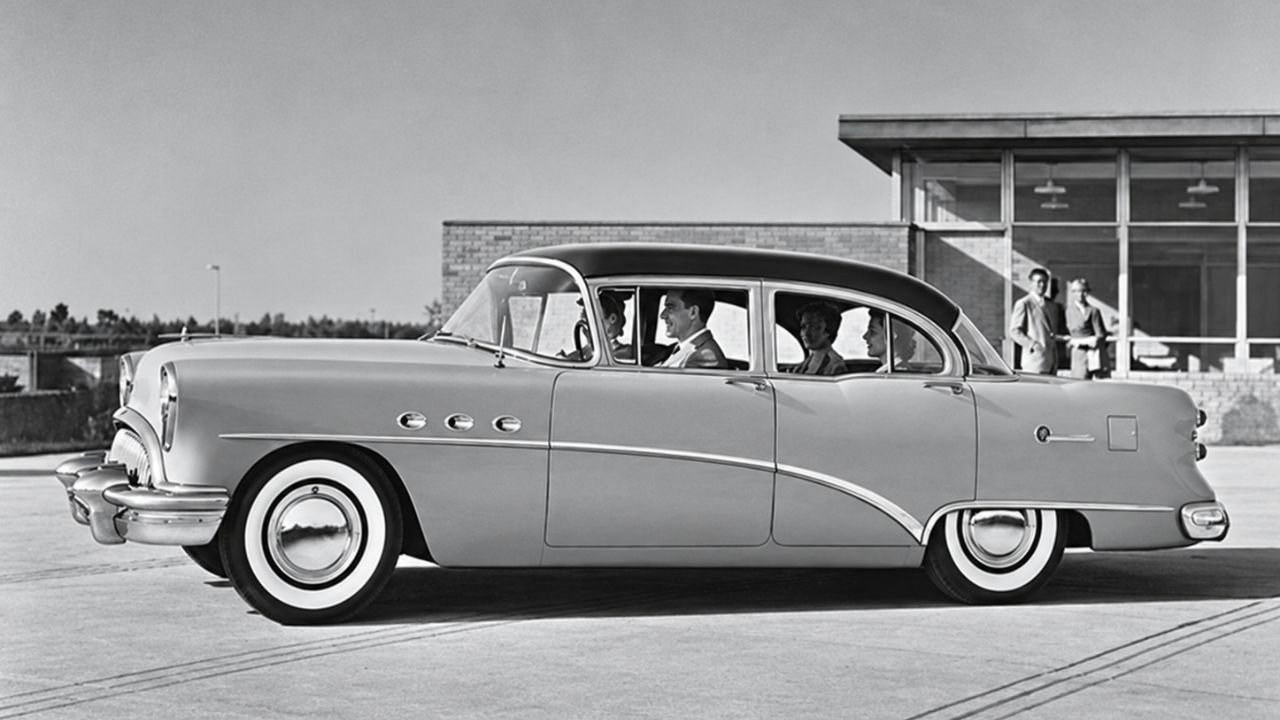
The biggest news in the lineup was a name from before the war. Buick had built the original Century from 1936, pairing the short Special body with the Roadmaster’s big 320-cubic-inch straight eight. It was good for 141 horsepower and a sustained 100 mph, which gave the car its name and its nickname: the banker’s hot rod. War ended it. Passenger car production stopped on February 4, 1942.
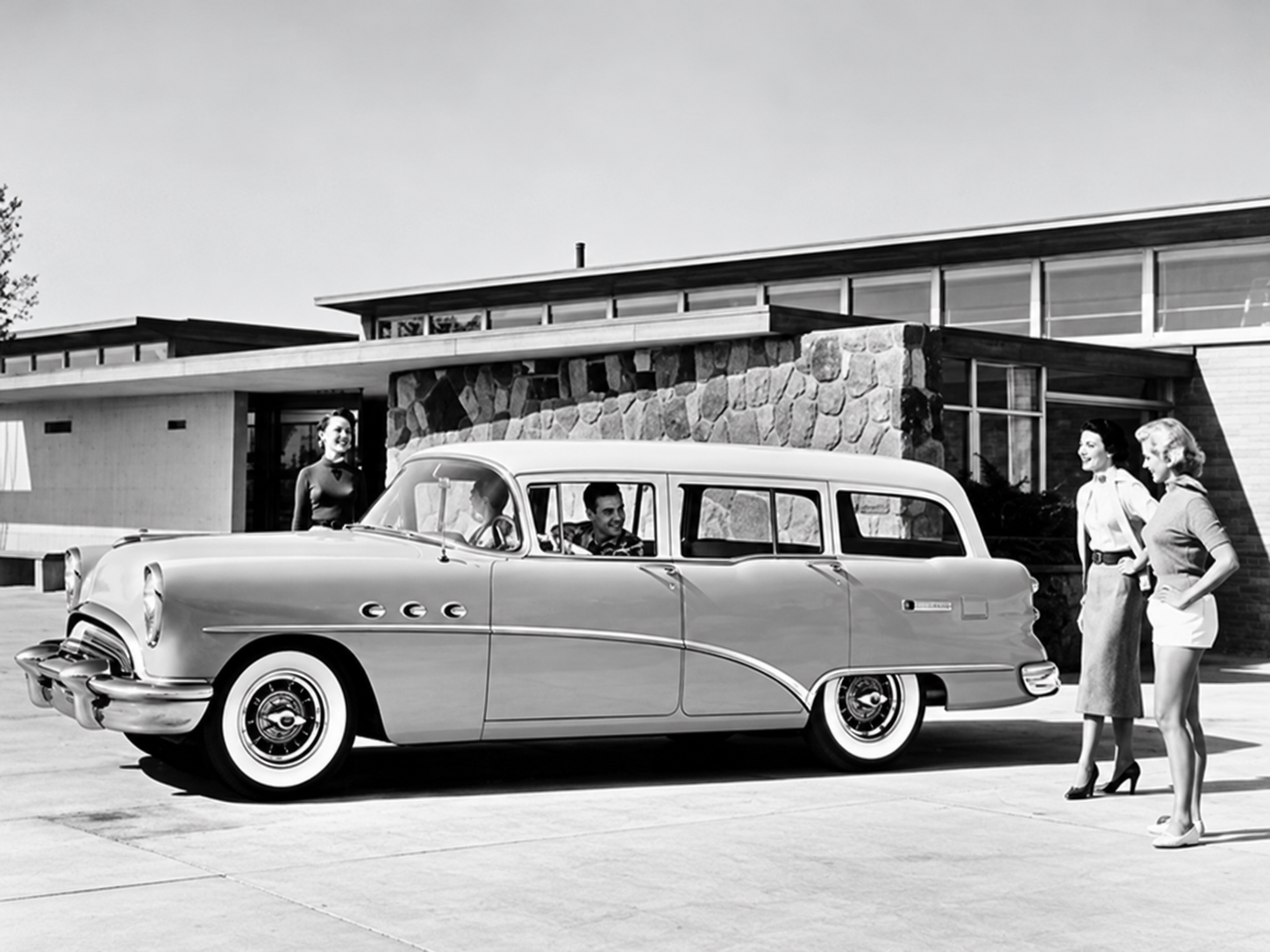
For 1954, Buick revived the formula exactly. Take the Special’s lighter body, install the Roadmaster’s 200-horsepower four-barrel V8, and price it in between. Conceptcarz puts the Century hardtop coupe and four-door sedan at about $2,525, roughly $300 more than a Special and about $200 less than a Super. The convertible listed at around $2,960, the Estate Wagon at about $3,470 (1954 dollars). Buick bought its wagon bodies from Ionia Manufacturing, which supplied all of them from 1946 to 1964.
Buyers understood the idea right away. The Century found 81,982 buyers in its first year back: 45,710 Riviera hardtops, 31,919 sedans, 2,790 convertibles and 1,563 wagons. The California Highway Patrol noticed too. For 1955 it ordered 270 two-door Century sedans, a body style Buick did not sell to the public, half with manual transmissions and half with Dynaflow.
The Skylark’s Last Season
At the top of the range sat the car with the smallest production. The 1953 Skylark had been a Roadmaster-based convertible built for Buick’s 50th anniversary, priced at just over $5,000 (1953 dollars), and 1,690 were built.
For 1954, Buick made it a series of its own, Series 100, and moved it onto the shorter Century chassis. It got the 200-horsepower V8, Dynaflow, power steering, power brakes and 40-spoke Kelsey-Hayes chrome wire wheels as standard. The wheel openings were cut out and could be painted in a contrasting color. The trunk sloped down, and the tail lights moved into chrome fins on top of the rear fenders. The design is generally credited to Harley Earl.
Buyers stayed away. Only 836 were built. Wikipedia gives the price as $4,843 and Over-Drive Magazine agrees, while Conceptcarz lists $4,483 in its text and $4,354 in its own table. Either way, the Skylark cost more than a Roadmaster convertible while riding on the smaller chassis, and many buyers seem to have seen it as a step down. Buick dropped it after 1954. The name came back in 1961 on a compact.
One concluded sale shows where the car sits today. At RM Sotheby’s Hershey auction in 2024, a 1954 Skylark sold for $42,900. It had left the factory in Lido Green with green leather and had since been repainted red with a black and white interior, which matters to collectors.
The Cars People Actually Bought
The Skylark made headlines. The Riviera hardtops made the money. The best-selling Buick of 1954 was the Super two-door Riviera hardtop, with 73,531 built, followed closely by the Special Riviera hardtop at 71,186. The Special series as a whole, including sedans, wagons and convertibles, accounted for more than 190,800 cars, about 43 percent of the total. The Century added about 18 percent.
Buick also offered a convertible in every series. The most popular was the Special convertible, with 6,135 built. The Super, Roadmaster and Century convertibles followed, with between 2,790 and 3,342 built each.
Third or Fourth Place
How well 1954 went depends on how you count. Over-Drive Magazine lists 444,609 cars for the model year. Allpar puts Buick at 513,497 cars, and Conceptcarz says Buick built more than 531,000 in calendar 1954, a record year, with nearly one in ten American buyers choosing a Buick.
The sales ranking depends on the counting method too. Mac’s Motor City Garage places Buick fourth in 1954, behind Chevrolet, Ford and Plymouth, and credits the move to third to 1955. Allpar and Conceptcarz say Buick was already third in 1954, with Plymouth falling to fifth behind Buick and Oldsmobile. The difference most likely comes down to model year versus calendar year figures.
What nobody disputes is what came next. For 1955, Buick built 738,814 cars and held third place in the American market, behind only Chevrolet and Ford. The foundation was the 1954 line: V8 power across the range, two new bodies, and a revived Century.
For a buyer in 1954, that was the beautiful buy. For anyone looking at these cars now, the Century is the one that tells the story best: the Roadmaster’s engine in the lighter body, the same recipe that had earned the name before the war.