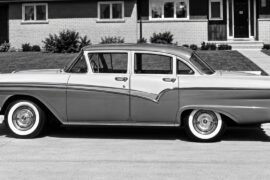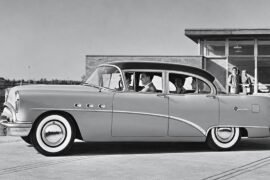
Mercury’s advertising for 1955 made a bold promise: “You don’t have to look twice to tell it’s a Mercury!” Underneath, the car shared its body structure with the Ford. On the outside, much of its look came from Lincoln and from a show car that had appeared in Chicago a year earlier. That mix worked better than anything Mercury had sold before.
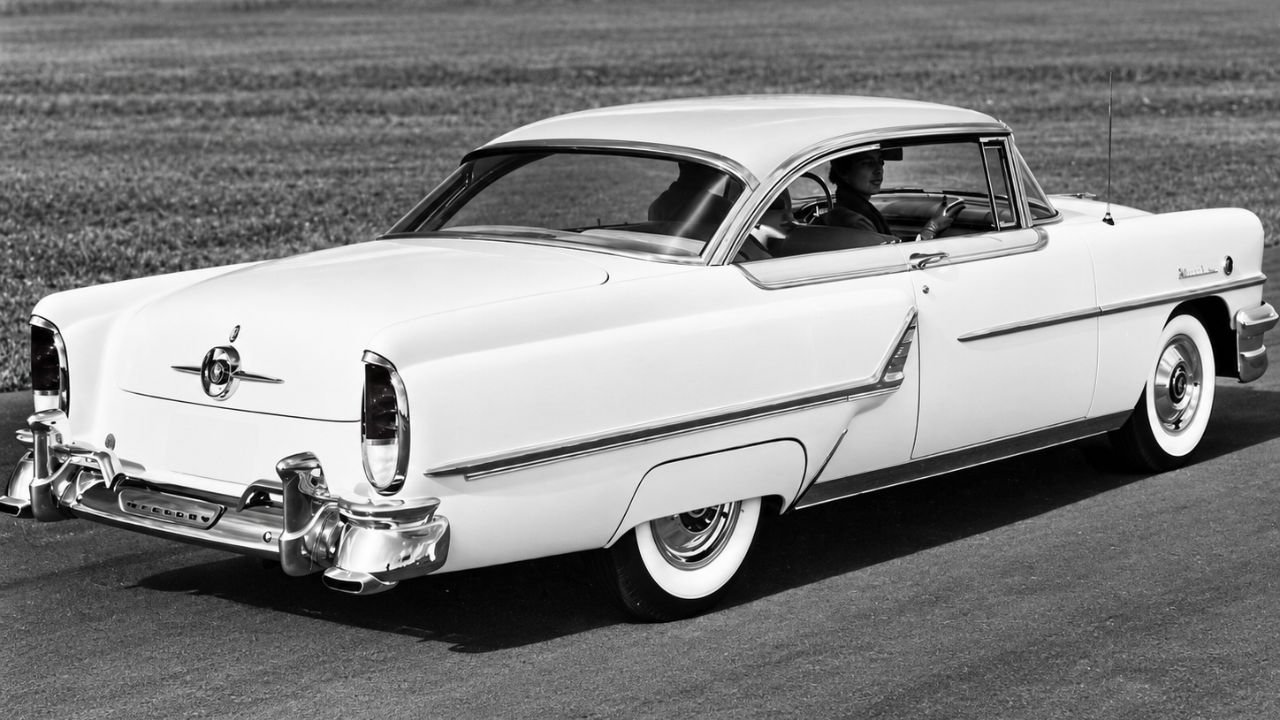
The division built 329,808 cars for 1955, a record and an increase of 27 percent over 1954. It still was not enough to change Mercury’s place in the market, and before the year was over, Mercury had been split from Lincoln and its longtime boss was on his way out.
The Look Came From a Show Car
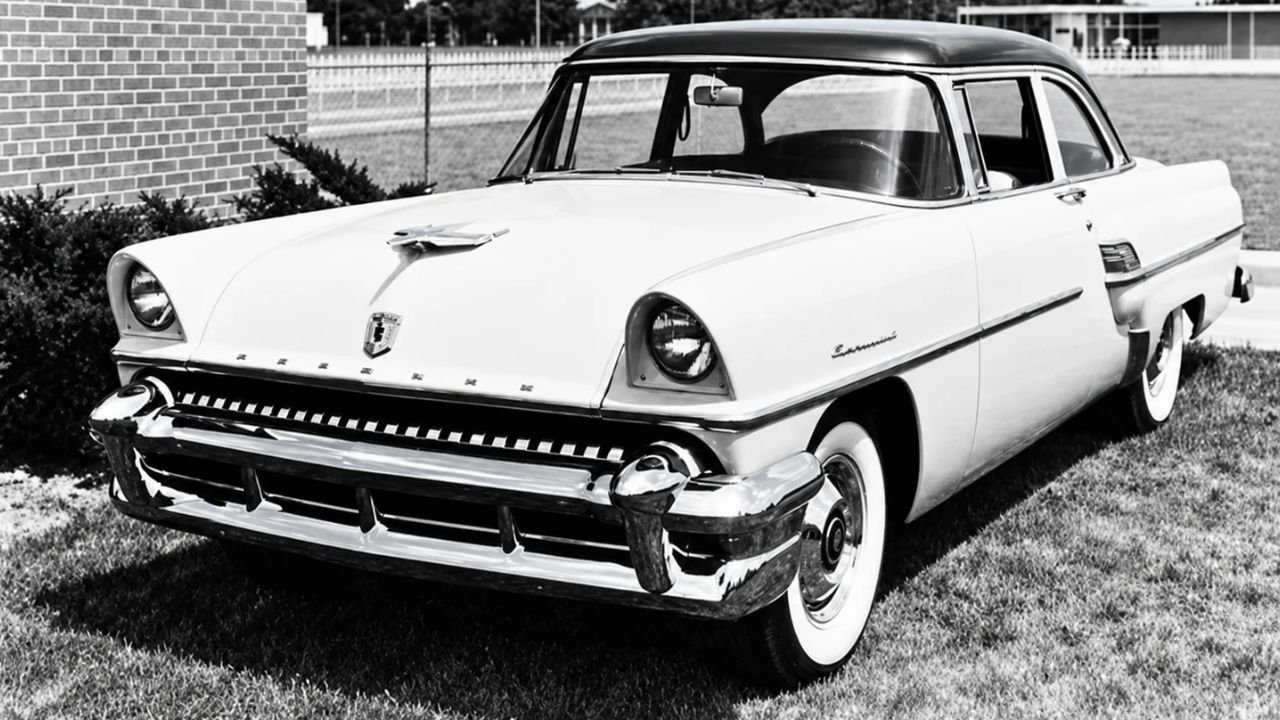
Mercury had shown the XM-800 at the Chicago Auto Show in 1954. Its styling cues soon turned up across Ford’s mid-1950s products, the Mercury Montclair among them. The production Mercury for 1955 got a canted hood that hung over the headlights, a wraparound windshield, a grille built into the bumper with three heavy vertical bars, and tall vertical taillights with a bulge that Over-Drive Magazine calls “chubby cheeks.”
Who gets the credit depends on whom you read. Mac’s Motor City Garage names veteran stylist Don DeLaRossa as the man who directed the new sheet metal. Dean’s Garage, which covers the Lincoln-Mercury studios of the period in detail, describes DeLaRossa as the executive in charge of Mercury’s preproduction studio, with Bill Schmidt heading Lincoln-Mercury design until he left for Packard in early 1955. On the XM-800 itself, Wikipedia credits John Najjar, while a 1957 University of Michigan student newspaper credited Schmidt.
The cars grew too. Wheelbase went up an inch to 119 inches for the passenger models, overall length to 205.5 inches. The wagons stayed on a 118-inch wheelbase, according to Conceptcarz. A padded dash and larger brakes became standard.
One Engine, Two Ratings
Every 1955 Mercury used the same engine: the 292-cubic-inch Y-block V8, with a 3.75-inch bore, a 3.30-inch stroke and a Holley four-barrel carburetor. What changed was the compression.
In the Custom and Monterey, a 7.6:1 compression ratio gave 188 horsepower at 4,400 rpm and 274 lb-ft of torque. The Montclair ran 8.5:1 for 198 horsepower and 286 lb-ft, and that version could be special-ordered on the cheaper lines. Wikipedia lists the Montclair at 195 horsepower instead, so the published figures do not quite agree.
A three-speed manual was standard. Buyers could add overdrive, which came with a 4.09 rear axle, or the three-speed Merc-O-Matic automatic, which used a 3.15 axle and only started in first gear at wide-open throttle.
Three Lines Instead of Two
Mercury expanded its range from two series to three. The Custom sat at the bottom, the Monterey in the middle, and the new Montclair at the top. Prices started at about $2,220 for the Custom two-door sedan and ran to about $2,845 for the Monterey wagon, according to Conceptcarz (1955 dollars). Mac’s Motor City Garage gives the range as $2,218 to $2,844. That spread placed Mercury squarely against Buick, Oldsmobile and Pontiac.
The Montclair was the headline. Curbside Classic, reprinting Motor Trend’s period test, notes that it was aimed at the Buick Century, the DeSoto Firedome and the Oldsmobile Super 88. It launched as a two-door only, with a four-door sedan added shortly after production began. A contrasting color panel ran below the side windows. The Montclair two-door hardtop listed at $2,631 (1955 dollars), and 71,588 were built, making it the best-selling Mercury of the year.
Motor Trend tested the other end of the range: a Custom sedan with Merc-O-Matic, radio and heater, and no power steering or power brakes. As tested, it cost $2,637 (1955 dollars), and the magazine found it capable and quick, with good handling.
Two Hardtop Rooflines
Mercury sold a two-door hardtop in all three series, and buyers took to it. Including the Sun Valley, hardtops added up to 149,508 cars, about 45 percent of Mercury’s volume.
They were not all the same car. The Montclair stood 58.8 inches tall, against 61.2 inches for the Custom and Monterey, which gave the top model a noticeably lower, sleeker roofline. Mac’s Motor City Garage notes that the Montclair hardtop shared its windshield with the convertible, and that Ford and Mercury moved all their two-door hardtops to the same low roof for 1956.
The rarest of them was the Montclair Sun Valley. Its tinted Plexiglas panel covered the front half of the roof. Unlike Ford’s pillared Skyliner, the Sun Valley was a true hardtop. It was also hot. Buyers complained about the heat in summer, and factory air conditioning did not arrive until 1956. Only 1,787 were built.
(BILD: 1955 Mercury Montclair Sun Valley, idealerweise von schräg oben, damit das getönte Plexiglas-Dachfeld zu sehen ist. Gut als Zweitbild, wenn möglich Seitenansicht Monterey Hardtop zum Vergleich der Dachhöhe.)
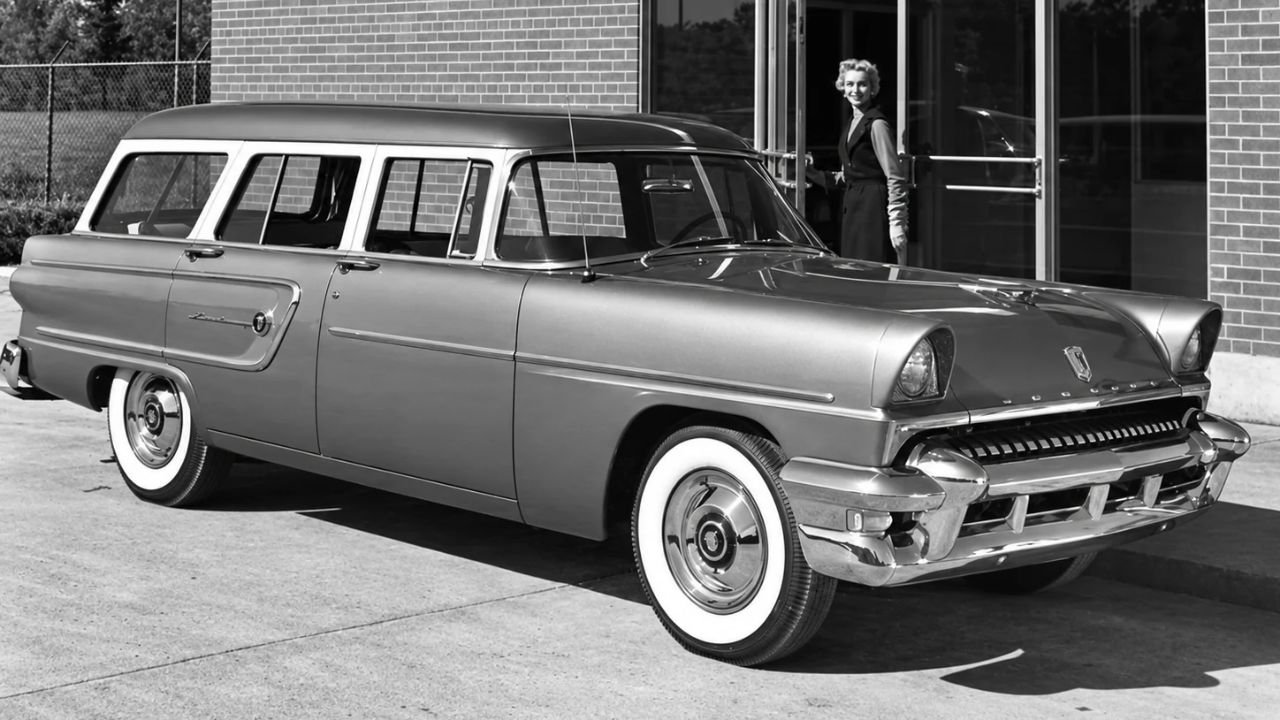
Wagons in Ford’s Shadow
Ford was chasing the station wagon market hard in the mid-1950s, and Mercury followed with two wagons of its own. The Custom wagon found 13,134 buyers, the eight-passenger Monterey 11,968. There was no Montclair wagon. Together that came to about 25,100 cars, well below Ford’s wagon volume. Mac’s Motor City Garage notes that the Monterey wore simulated wood trim in the style of Ford’s Country Squire, while the Custom used a bright metal treatment.
Change at the Top
The car was new, and so was the organization behind it. Benson Ford, brother of Henry Ford II and William Clay Ford, had run the Lincoln-Mercury Division since 1948. In spring 1955, Lincoln and Mercury became separate divisions.
According to Dean’s Garage, the split grew out of a plan presented to Ford’s Product Planning Committee on February 7, 1955, by Jack Reith, a protégé of Ford Division chief Lewis Crusoe. The $250 million plan called for separate Lincoln and Mercury divisions, a new division that would become Edsel, and a new 1957 Mercury based on the Turnpike Cruiser show car. Benson Ford was the only committee member to vote against it. Within months, Crusoe recommended removing him, and Reith took over Mercury. Benson Ford’s run as head of Lincoln-Mercury ended in 1956.
A Record Year, Same Position
The numbers were the best Mercury had ever posted. The Monterey was the volume leader with 151,453 cars, about 46 percent of the total. The new Montclair added 104,667, almost a third. The Custom accounted for 73,688, according to Curbside Classic. Over-Drive Magazine’s body-style figures add up to 72,688 for the Custom and 328,808 overall, a thousand cars short of the usual total.
Yet the market as a whole grew faster. Curbside Classic points out that U.S. sales rose 47 percent in 1955, against Mercury’s 27, and that GM and Chrysler took most of the gain. Buick, for one, built 738,814 cars that year. Mac’s Motor City Garage puts Mercury in seventh place, the same spot it held before.
That was the paradox of the 1955 Mercury. It was easy to spot on the road, its best seller had a Lincoln-style look at a Mercury price, and it set a sales record. But it did not move the brand up, and within two years Mercury would be selling a very different car under very different management.