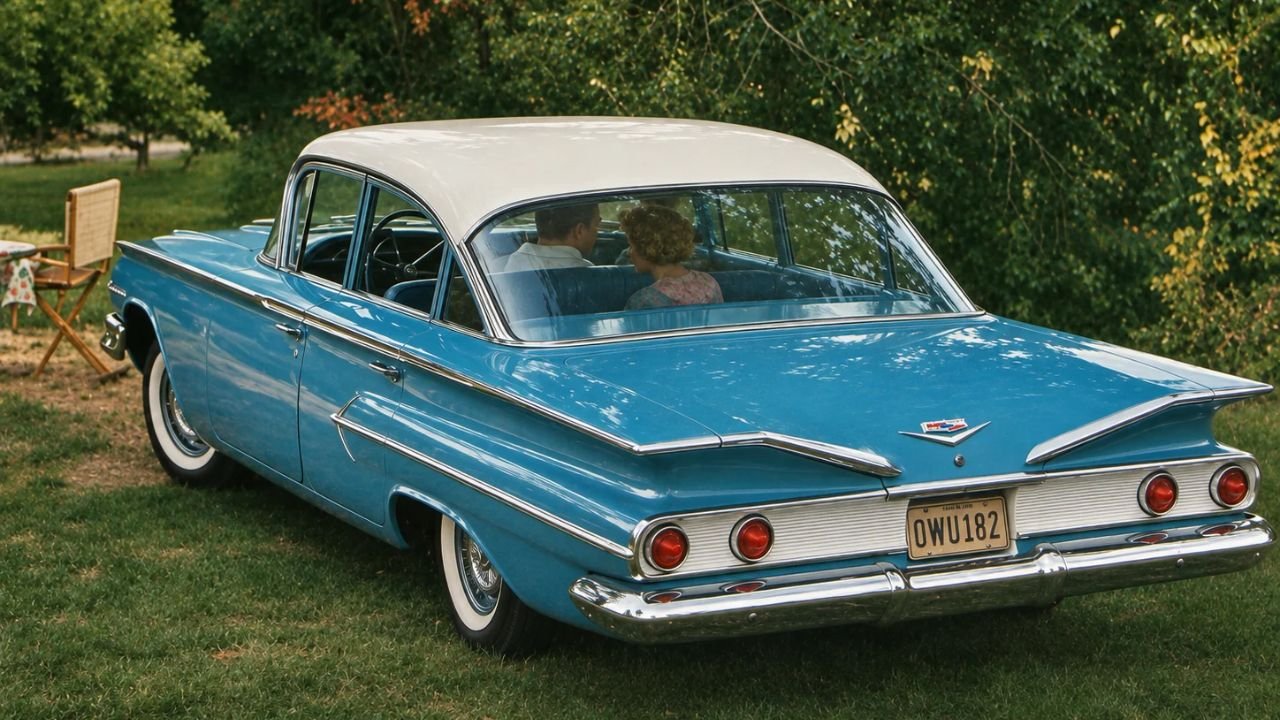
The 1959 Chevrolet looked like nothing else on the road, with gull-wing fins, cat’s-eye taillights and eyebrows over the grille. For 1960, Chevrolet calmed it down. The advertising promised “everybody’s kind of elegance,” and the car underneath the new sheet metal was nearly the same.
Calm did not mean slow. The same 1960 Chevrolet that wore the quieter styling could still be ordered with a 348-cubic-inch V8, three two-barrel carburetors and 335 horsepower. And Chevrolet built more than 1.65 million cars that model year.
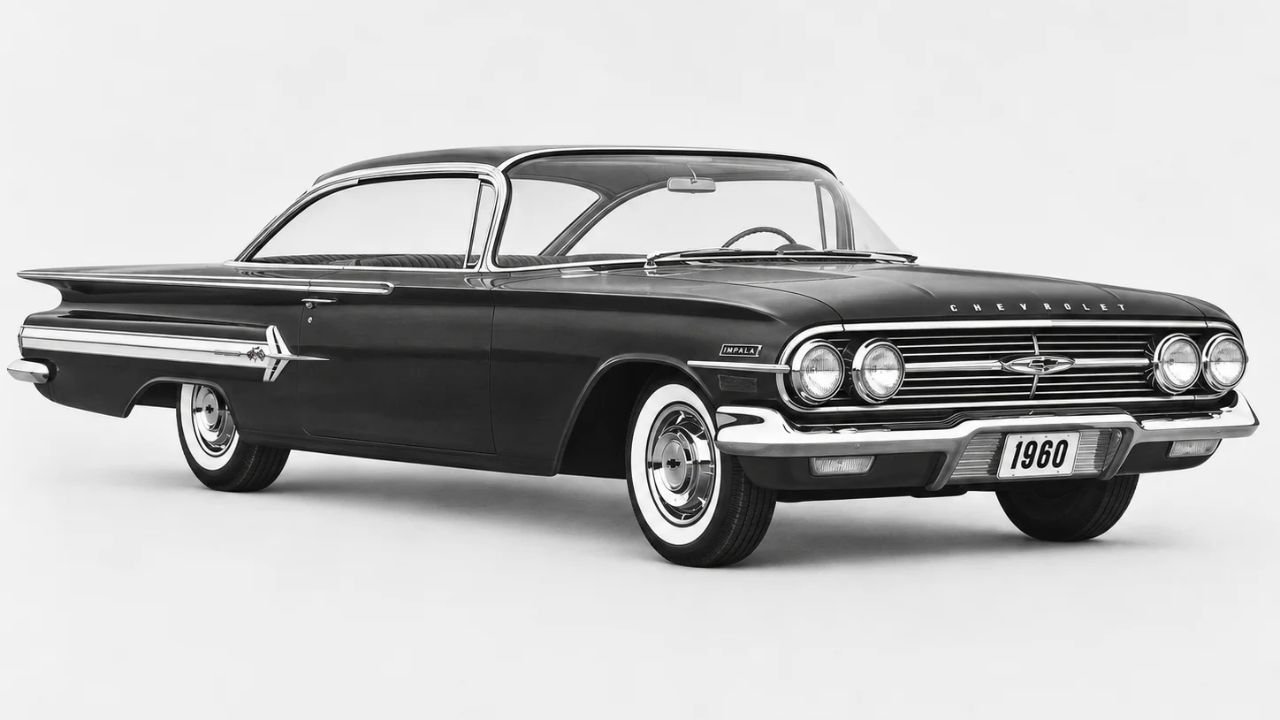
Same Car, New Skin
Chevrolet kept the expensive parts. The X-frame chassis and the 119-inch wheelbase carried over from 1959. Over-Drive Magazine lists the 1960 car at 210.9 inches long and 79.9 inches wide. Curbside Classic notes that the changes were limited mostly to the outer skin, to avoid costly retooling, and that the interior was nearly identical apart from upholstery patterns and details.
What changed was the attitude. The 1959’s eyebrows above the grille disappeared, and a simple oval grille now framed the four headlights. The fins at the back were rebuilt from two straight sections into a flatter, more angular shape. According to Mac’s Motor City Garage, Chevrolet studio chief Clare MacKichan later recalled that the team did not want to give up the fins entirely, so they reshaped them instead.
The cat’s-eye taillights gave way to round lamps set in a rear beauty panel. The Impala got three on each side, the cheaper models two. Over-Drive Magazine adds that Chevrolet toned down the styling after buyer complaints about the 1959.
The Flat Roof That Every GM Brand Shared
Under the skin, Chevrolet was not alone. In 1959 and 1960, GM’s divisions shared the same basic body structure, and Wikipedia notes that the bodyshell was shared with the lower-priced Buicks, Oldsmobiles and Pontiacs as an economy measure.
The most striking result was the four-door hardtop with a flat, overhanging roof and a huge wraparound rear window. Chevrolet called it the Sport Sedan. Curbside Classic traces the idea to Masaji “Bud” Sugano, a GM body layout engineer who reportedly proposed it in the early 1950s, and notes that versions of the theme appeared on the Corvette Nomad show car and the 1955 Pontiac Strato Star concept. Mac’s Motor City Garage says 1960 was the last year for the flat-top at Chevrolet.
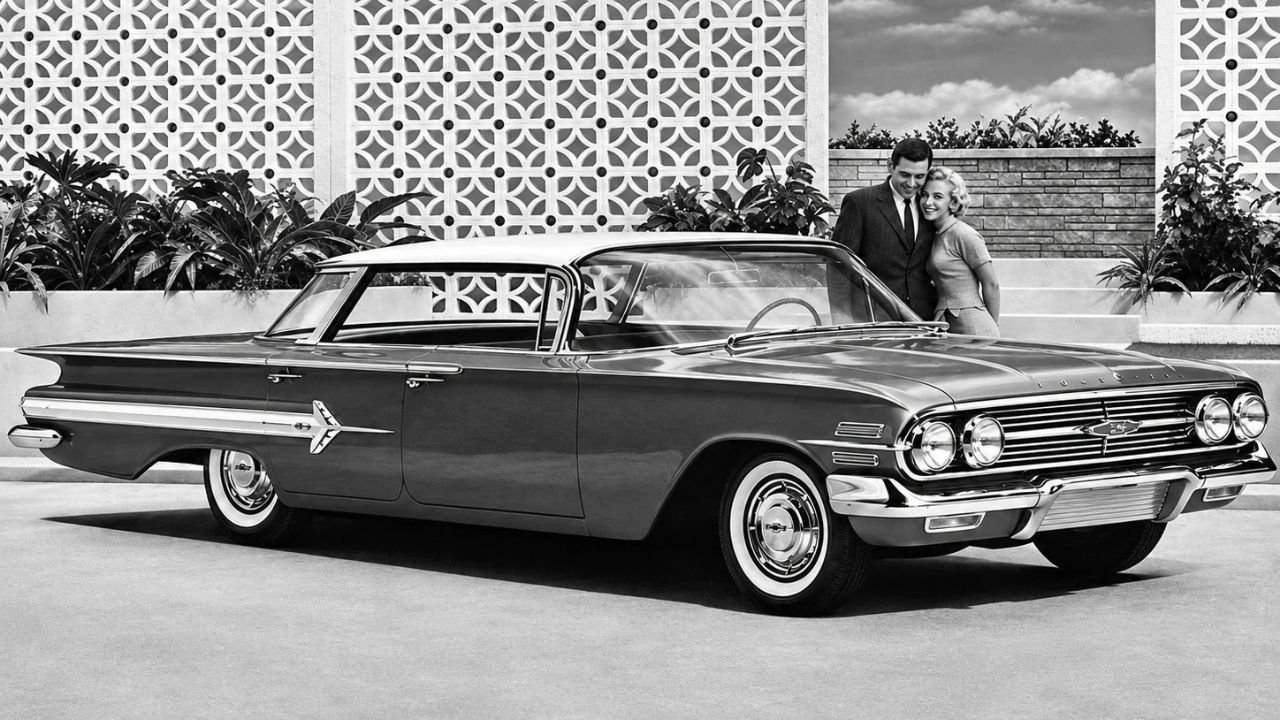
Three Names That Lasted
The lineup was easy to read. Biscayne at the bottom, Bel Air in the middle, Impala at the top. Mac’s Motor City Garage presents this as the new order for 1960, but the structure was already in place in 1959, when Chevrolet dropped the one-year Delray, according to Wikipedia. The Biscayne itself had first appeared for 1958.
For 1960, the Biscayne came only as a two-door or four-door sedan. Below it sat the Fleetmaster, a sparsely trimmed fleet version with lower-grade upholstery, no cigarette lighter, no passenger-side sun visor and painted parts instead of chrome. Fewer than 5,000 were built over its run. The Bel Air and Impala offered two-door and four-door hardtops, and the Impala convertible was the only full-size Chevrolet convertible. Over-Drive Magazine lists 79,903 of them.
The wagons had their own names, from Brookwood to Parkwood, Kingswood and the top Nomad. 1960 was also the last year for the full-size El Camino, with 14,163 built, and for the Sedan Delivery.
From a Six to a Tri-Power 348
Engine choices covered a wide range. The base engine was the 235-cubic-inch six with 135 horsepower. The 283 V8 came with a two-barrel or a 230-horsepower four-barrel. Over-Drive Magazine lists the two-barrel at 185 horsepower, while Chevy Hardcore gives 170. Then came the 348, the big W-series V8, in five versions from 250 to 335 horsepower.
The top engine was the 348 with three two-barrel carburetors, 11.25:1 compression and mechanical lifters. Over-Drive Magazine rates it at 335 horsepower at 5,800 rpm and 362 lb-ft, and lists it for manual transmissions only. Wikipedia mentions a 350-horsepower figure instead, but Over-Drive, Chevy Hardcore and Old Cars Weekly all give 335.
What was gone was fuel injection. Wikipedia and Chevy Hardcore both note that the fuel-injected 283 was no longer offered in full-size Chevrolets for 1960. Mac’s Motor City Garage adds that it was now reserved for the Corvette.
Five transmissions were available: the three-speed manual, a three-speed with overdrive, a close-ratio four-speed, Powerglide and Turboglide.
What the Fast One Cost
Old Cars Weekly reconstructed the original price of one well-optioned 1960 Impala from a dealer price list. The Impala two-door hardtop started at $2,841. The 335-horsepower 348 added $333, the four-speed $188.30 and Positraction $43.05. With wheel covers, a manual radio and two mirrors, the car came to about $3,488 (1960 dollars).
Over-Drive Magazine lists the rest of the options sheet: $199 for Powerglide, $242 for Turboglide, $468 for air conditioning with heater and $135 for air suspension (1960 dollars).
That particular car, found by Wisconsin collector Larry Fisette and reported by Old Cars Weekly in 2015, was an unrestored survivor with 64,000 miles and its original four-speed shifter. The article calls the combination of 335-horsepower 348, four-speed and Positraction a rarity.
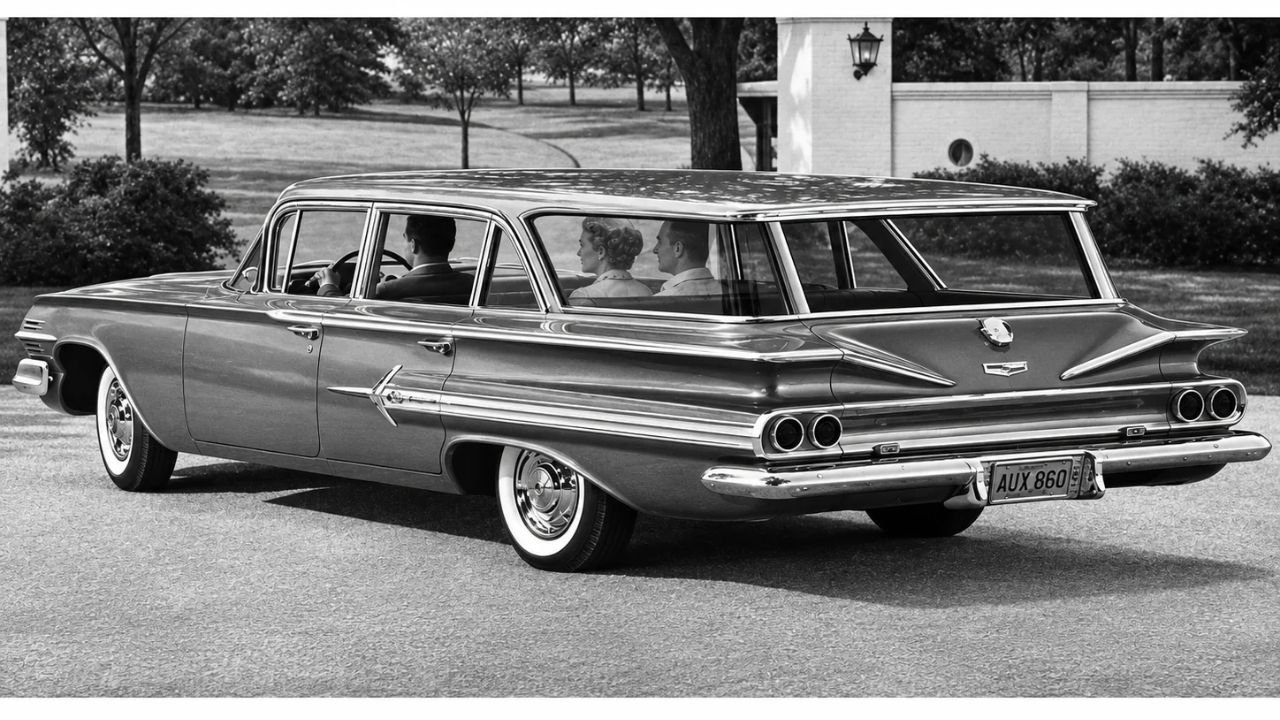
1.65 Million and Counting
The numbers were enormous. Conceptcarz lists Chevrolet production for the 1960 model year at 1,653,168 cars. Mac’s Motor City Garage notes that this was far more than all four other GM car divisions combined and puts the Impala at more than 440,000, the best-selling series, ahead of the Bel Air and Biscayne. That Impala figure comes from Mac’s alone.
The big cars were no longer the whole story. The new rear-engine Corvair added 250,007 cars in the United States in its first year, according to figures from Tony Fiore’s book The Corvair Decade. The Chevy II followed for 1962, the Chevelle for 1964 and the Camaro for 1967.
Seen from today, the 1960 Chevrolet sits between two very different eras. It had the long, low body and the fins of the 1950s. It also had the cleaner lines, the big-block V8 power and the growing family of smaller cars that would shape Chevrolet in the 1960s.