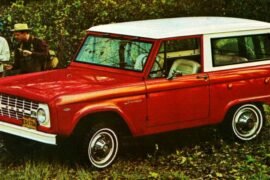
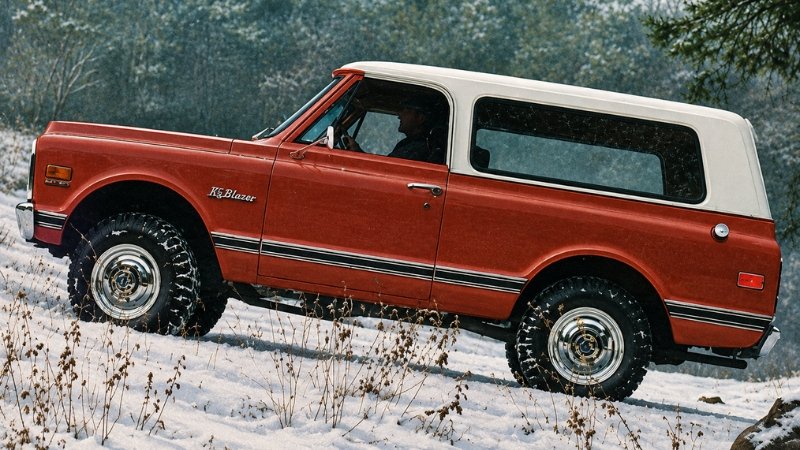
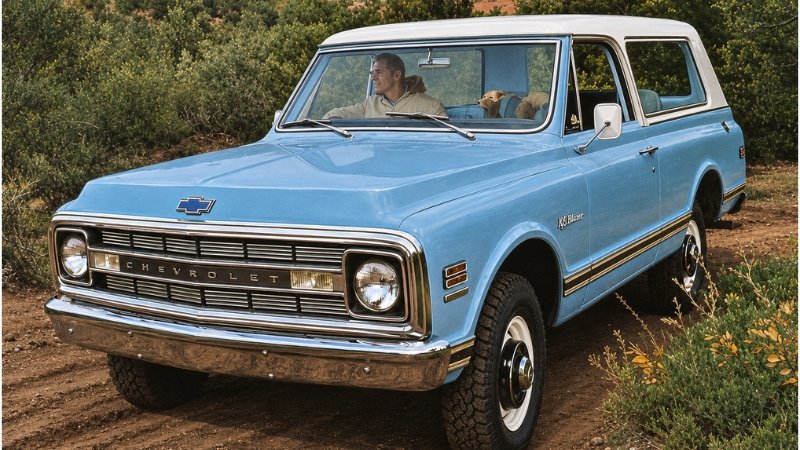
Most people picture the early Chevrolet Blazer the same way: short, boxy, top off, four-wheel drive, somewhere on a dirt trail. That is the K5 Blazer, and it is the one collectors chase. But for 1970, Chevrolet also built a version that most buyers never saw, with two-wheel drive, coil springs up front and, in part, a U.S. Postal Service commitment behind it. In Chevrolet’s model codes, it was a C10 Blazer, and fewer than 1,000 were built in its first year.
A Pickup With the Back Cut Off
Chevrolet introduced the Blazer for the 1969 model year. Wikipedia describes it as a shortened pickup, designed to compete with the International Harvester Scout and the Ford Bronco. Sharing parts with the full-size trucks kept production costs down and gave buyers more room than the smaller rivals offered.
The ck5.com specification archive, compiled by owners, lists a 104-inch wheelbase. The first Blazer came only with four-wheel drive, and the top was removable. It was offered with the 250-cubic-inch six and the 292 six, plus the 307 and 350 V8s.
It worked. Jim Carter Truck Parts, a Chevrolet truck specialist, writes that dealers were caught off guard by demand in 1969 and that waiting lists formed for the new model. Chevy Hardcore puts first-year production at about 4,935. By 1970, according to Wikipedia, the Blazer was already outselling both the Bronco and the Scout.
The Two-Wheel-Drive Blazer
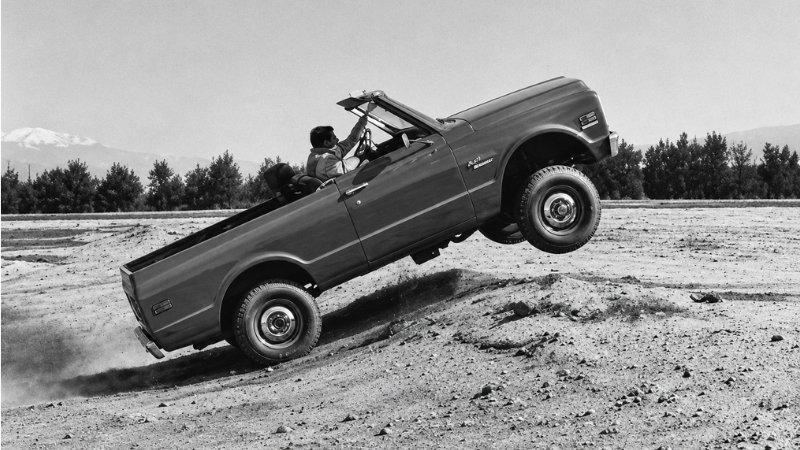
For 1970, Chevrolet added a two-wheel-drive version. The reason was partly practical. Jim Carter Truck Parts says the 2WD Blazer and its GMC Jimmy twin were built in part because of commitments to the U.S. Postal Service. Most government orders came with six-cylinder engines, though some private buyers ordered V8s.
The 2WD truck was more than a 4WD Blazer without a front driveshaft. Wikipedia notes that it used independent front suspension and trailing arms at the rear, with coil springs at both ends. The 4WD Blazer used a solid front axle and leaf springs front and rear. Both versions had drum brakes on all four wheels until 1971, when front discs became standard on GM light trucks.
The price gap was real. Oldride.com lists the 1970 4×2 Blazer from $2,385 and the 4×4 from $2,955, both factory prices in 1970 dollars. The model codes on the same list begin with C for the two-wheel-drive trucks and K for the four-wheel-drive versions, which is where the C10 and K10 names come from.
How Rare Is It?
Exact numbers are hard to find. Jim Carter Truck Parts says fewer than 1,000 two-wheel-drive Blazers and Jimmys were built in 1970, less than 10 percent of total production. The ck5.com archive also gives a figure below 1,000 for that year.
The sources do not agree on when it began. Ck5.com notes that factory records list a 4×2 model number for 1969, but that none were built that year. It also mentions that some sources date the 2WD Blazer to 1971, while factory records show close to 1,000 built in 1970. Chevy Hardcore and Wikipedia both give 1970 as the first year.
For context, ck5.com lists 11,527 four-wheel-drive Blazers for 1970 and 17,220 for 1971. Chevy Hardcore gives the same 1970 figure.
Engine ratings also vary by source. Oldride.com lists the base 250 six at 155 horsepower, while ck5.com gives 110 for the same engine. The difference most likely comes from gross versus net ratings, but neither source says which it uses.
GMC’s Version
GMC entered the picture in the Blazer’s second year. According to Jim Carter Truck Parts, the GMC version replaced the Chevrolet and Blazer badges with GMC lettering and a Jimmy emblem. Wikipedia confirms that GMC introduced the Jimmy for 1970, the same year the two-wheel-drive version appeared.
Car and Driver wrote about the Blazer in its April 1970 issue. Jim Carter quotes the magazine as saying the drivetrain parts were well designed, rugged and long proven in Chevrolet’s light trucks. GM marketed the Blazer as a vehicle that could do anything and go anywhere.
Later Years
The 2WD Blazer did not disappear after 1970. Wikipedia notes that rear-wheel-drive Blazers were built until 1982, although most buyers chose four-wheel drive.
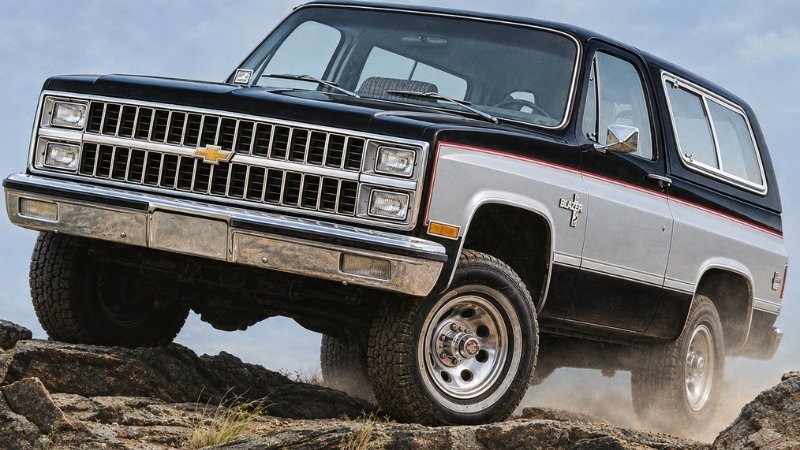
The truck itself changed a lot along the way. For 1973, it moved to GM’s redesigned full-size truck platform, and ck5.com lists the wheelbase at 106.5 inches from that year. The fully removable top was offered until 1975. For 1976, Chevrolet introduced a half-cab design with a fixed steel roof over the front seats and a removable top behind them, which Wikipedia says was less prone to leaks and slightly safer in a rollover.
The full-size Blazer lasted until 1994. Its successor, the Tahoe, arrived for 1995.
In the Market Today
Market data for the two-wheel-drive version is thin. One example: a customized red 1970 Blazer 2WD with 388 miles shown was offered at Mecum’s Kansas City auction on December 2, 2023. Classic.com records a high bid of $45,000, and the truck did not sell. Its listing gave no engine details, and its condition was described only as custom.
The clearest mechanical difference from a K5 remains the front end. A factory two-wheel-drive Blazer has independent front suspension with coil springs, not a solid axle on leaf springs, and its model code starts with C instead of K.