Pontiac expected to sell about 5,000. By the end of the 1964 model year, buyers had ordered 32,450 Tempests with the GTO package, a $295 option that put a big-car V8 into a mid-size body. It was not the first fast American car, and it was not the first big engine in a smaller car. But it was the one that sold, in numbers nobody at Pontiac had planned for.
A Way Around the Rules
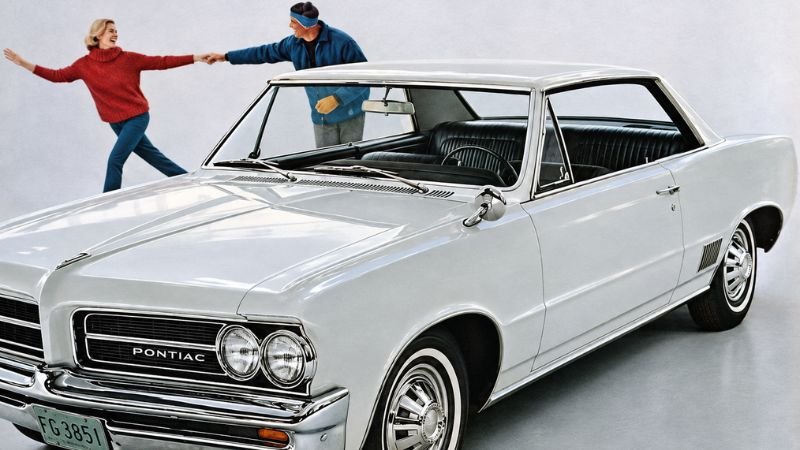
In the early 1960s, GM had a rule that limited its intermediate A-body cars to engines of 330 cubic inches or less. According to Wikipedia, citing Jim Wangers’ autobiography Glory Days, John DeLorean, Bill Collins and Russ Gee found the gap in that policy. It covered the cars, not the options. So the 389-cubic-inch V8 from the full-size Grand Prix went onto the order form as part of an option package for the new Tempest LeMans.
SlashGear describes DeLorean as the car’s champion inside Pontiac and notes that he went on to become, at 40, the youngest division head at GM. The marketing restrictions were as tight as the engineering ones, and the GTO could not be advertised openly as a performance special.
The name was borrowed from Ferrari. GTO stood for Gran Turismo Omologato, Italian for a grand touring car homologated for racing, and Ferrari already used it on the 250 GTO. Pontiac’s GTO had never been homologated for anything.
What $295 Bought
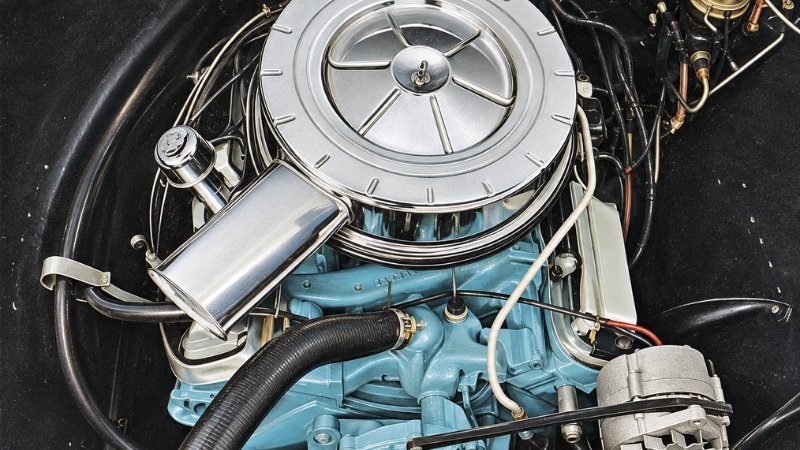
The package price is given as $295 by Wikipedia and $296 by the Pontiac parts supplier OPGI, both period figures. Either way, the buyer got the 389 with a four-barrel carburetor and 325 horsepower. With the optional Tri-Power setup of three two-barrel carburetors, the rating rose to 348.
OPGI lists the rest of the standard equipment: a floor-shifted three-speed manual with a Hurst shifter, dual exhaust, chrome valve covers and air cleaner, a heavier-duty handling package, hood scoops and 7.50 x 14 redline tires. Positraction and better cooling cost extra. The car weighed close to one pound per horsepower, according to OPGI.
The GTO was available as a two-door sport coupe, hardtop or convertible.
The Ringer
The car’s reputation got a large push from a single magazine story, and that story was not entirely what it seemed. The March 1964 issue of Car and Driver set the Tempest GTO against the Ferrari GTO, with a cover line claiming 0 to 100 mph in 11.8 seconds.
Hagerty explains how that happened. Wangers, a Detroit advertising and public relations man who worked on Pontiac’s account, arranged the test. The red car used for the acceleration runs had left the factory with a Tri-Power 389, but Pontiac engineering had replaced it with a 421 H.O. from the larger Catalina, along with a close-ratio four-speed and 3.90 gears. It was built without sound insulation or seam sealer to save weight. Power steering and a power antenna helped it look like an ordinary dealer car.
At Daytona International Speedway, between Christmas and New Year’s 1963, it ran 0 to 60 mph in 4.6 seconds and the quarter mile in 13.1 seconds at 115 mph. A second car, blue and fitted with the regular 348-horsepower Tri-Power, did the road course and handling tests. Wangers knew the numbers were too good, Hagerty writes, but he said nothing. He revealed the details only in his 1998 memoir.
The red car survives. It was later restored to its test configuration.
Tigers and Records
Pontiac’s marketing quickly settled on one animal. According to PontiacV8.com, the earliest tiger references in Pontiac ads date to 1963, and Pontiac called the 1964 GTO its “new tiger.” U.S. Royal supplied the tires and called them “the tiger’s paw.” In 1965 and 1966, ads and TV commercials featured tiger stripes and live tigers, and Pontiac sent tiger material to its dealers free of charge. Royal Pontiac, the dealership that later fitted the test car with a fresh 421, ran its own GeeTO Tiger drag racing program.
Pop music helped as well. Ronny and the Daytonas reached the Top 40 with “Little GTO,” OPGI notes.
The sales numbers followed. Wikipedia lists about 75,342 GTOs for 1965 and 96,946 for 1966, the highest total of any GTO year. For 1965, the base 389 was rated at 335 horsepower and the Tri-Power at 360.
Its Own Model
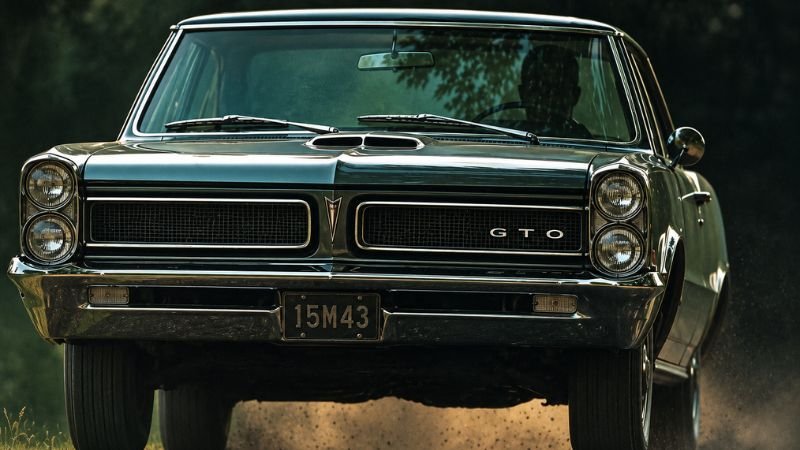
For 1966, the GTO was no longer an option. Pontiac made it a separate model with its own series, Wikipedia notes, and gave it Coke-bottle styling and a plastic grille.
The engine grew to 400 cubic inches for 1967, and Tri-Power was replaced by a single Quadrajet carburetor. Pontiac offered three versions of the 400: an economy engine with 265 horsepower, the standard 335-horsepower engine and a high-output version with 360. Production for 1967 was 81,722.
For 1968, the GTO got a new body and a body-color Endura front bumper made of flexible plastic. The standard engine was rated at 350 horsepower. Motor Trend named the GTO its Car of the Year, and production reached 87,684.
Here Come the Judge
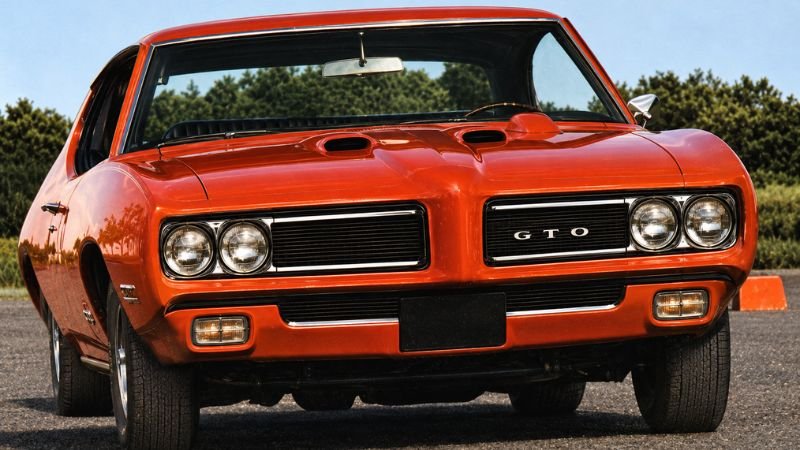
By 1969, the GTO had a new problem. Plymouth’s Road Runner offered serious performance at a low price. Old Cars Weekly notes that Pontiac first planned The Judge as a cheaper GTO to compete with it. The finished car was something else: a package that cost $332.07 more than a regular GTO.
What the extra money bought was a Ram Air III 400, rated at 366 horsepower and 445 lb-ft, a rear spoiler and bold graphics. The first couple of thousand Judges came only in Carousel Red, a color Old Cars Weekly says actually looks orange. The name came from the “Here Come the Judge” routine on Rowan and Martin’s TV show. Old Cars Weekly credits Flip Wilson, while SlashGear names Sammy Davis Jr.
The Ram Air IV, rated at 370 horsepower, was available in both the GTO and the Judge. Old Cars Weekly estimates that about 200 of the more than 72,000 GTOs sold for 1969 had it, and it says there is no reliable count for Judges.
Pontiac sold 6,833 Judges for 1969 and 3,797 for 1970, according to Old Cars Weekly. SlashGear reports just 108 Judge convertibles. The sources disagree on the end: Wikipedia and Old Cars Weekly give 1971 as the final year of the Judge, while SlashGear says 1970.
The Long Decline
For 1970, Pontiac added the 455 HO, rated at 360 horsepower. Sales were already falling. GTO production fell to 40,149 that year and 10,532 for 1971, when lower compression ratios and the switch to net ratings cut the published numbers.
For 1972, the GTO went back to being an option package on the LeMans, priced at $353.88, and sales dropped to 5,811. The 1973 GTO used GM’s new Colonnade body with heavy bumpers, and only 4,806 were built. A Super Duty 455 was tested for it but never sold to the public, according to Wikipedia.
The last original GTO was a $461 option package on the compact Ventura for 1974, with a 350 V8 rated at 200 horsepower. Pontiac sold 7,058 and then dropped the name. It returned from 2004 to 2006 on a rebadged Holden Monaro built in Australia, which Wikipedia notes was discontinued because it could not meet new airbag standards for 2007.