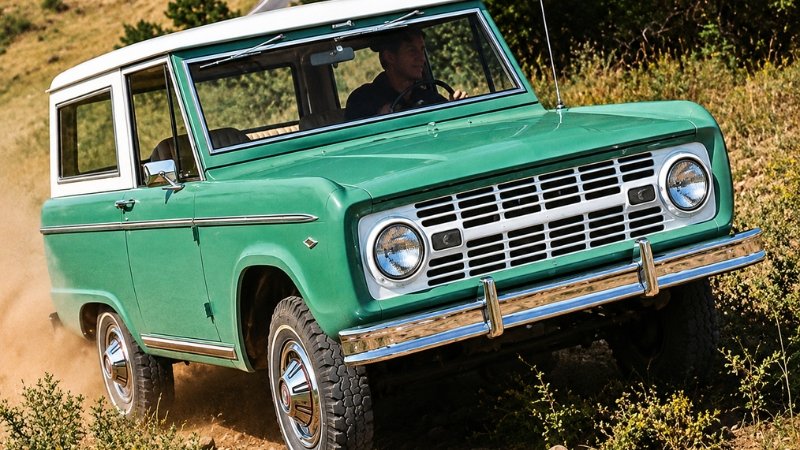
On August 11, 1965, Ford showed the public a vehicle that did not fit any of its existing categories. It was not a pickup, not a station wagon and not a Jeep. The company’s ads called it “a new kind of sports car.” Ford named it Bronco, a deliberate nod to the Mustang, and in its first year nearly 24,000 people bought one.
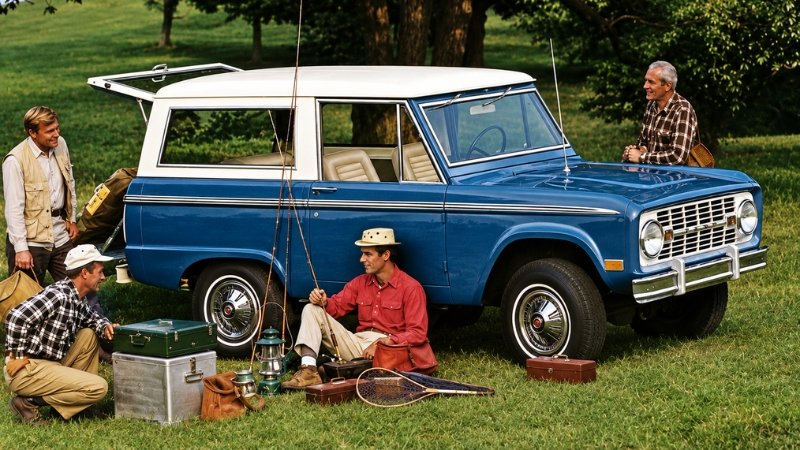
The GOAT
The project started in the early 1960s. Wikipedia credits product manager Donald N. Frey with the idea and engineer Paul G. Axelrad with developing it. Mac’s Motor City Garage, which calls Frey one of the fathers of the Mustang, notes that the internal name was GOAT, for “Goes Over All Terrain,” and that Ford stylist McKinley Thompson drew the first renderings.
Ford did its homework. Expedition Portal describes market research showing that buyers wanted higher cruising speeds, a better ride, weather-tight cabs, comfortable seats and easy access to parts and service, without losing off-road ability. On February 12, 1964, senior management approved the styling and set aside $10 million for development and production. Wikipedia names Lee Iacocca as the executive who signed off that month.
To keep costs down, Ford borrowed what it could. The 170-cubic-inch six came from the Falcon, and the optional bucket seats from the Mustang, according to Expedition Portal.
Built for the Trail
Unlike the full-size trucks, the Bronco had a frame of its own. Wikipedia gives a 92-inch wheelbase, and Mac’s points out that this was well over the 81 inches of the Jeep CJ-5, which meant more room and a better ride.
Every Bronco had four-wheel drive. Mac’s lists a Dana 30 front axle with locking hubs, a Dana 20 transfer case and a Ford 9-inch axle at the rear. The front axle was the clever part. Wikipedia notes that it rode on coil springs and was located by radius arms and a track bar, which gave long wheel travel and a turning circle of 34 feet. The rear used leaf springs.
The early engines were modest. At launch, the Bronco had the 170 six with solid lifters, rated at 105 horsepower and paired with a three-speed manual. From March 1966, buyers could order the 289 V8 with 200 horsepower. An automatic transmission did not arrive until 1973.
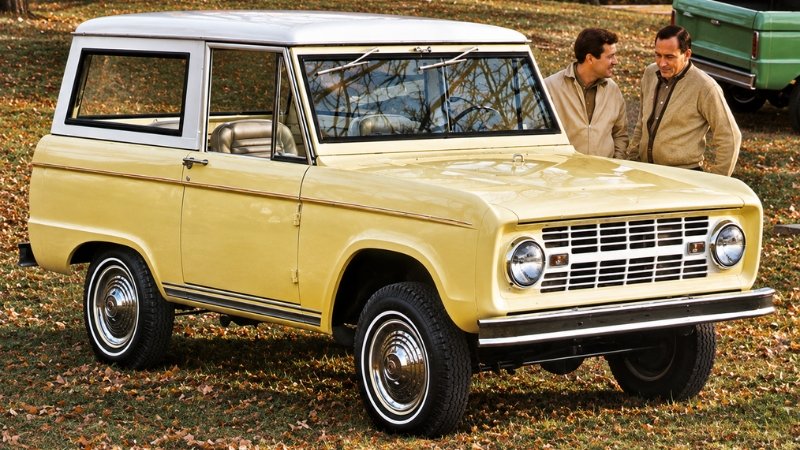
Three Bodies
For 1966, Ford offered three versions. Mac’s Motor City Garage lists the prices as $2,386 for the Roadster, which had no doors or top, $2,479 for the Sports Utility, a half-cab pickup with a bolt-on steel roof, and $2,551 for the Wagon, with a full-length steel top. Those are period figures. Wikipedia gives a lower base price of $2,194, and the sources do not explain the difference.
A bench seat was standard, and front buckets and a small rear seat cost extra. Expedition Portal notes that the Wagon accounted for slightly more than half of production.
The Roadster went first. Ford dropped it after 1968, and Mac’s lists it as the rarest body style, with a figure of 212 that it does not tie to specific years. The half-cab was gone after 1972, which left only the Wagon.
Sales on a Small Scale
Wikipedia lists 23,776 Broncos for 1966. The second year was the weakest of the run, at 14,230. Volume picked up again later, with a peak of 25,824 in 1974, and the final year, 1977, ended at 14,546. Mac’s puts the total for the first generation at about 207,000.
Those are small numbers by Ford standards, and the competition did not stand still. Hagerty notes that Jeep and International already had vehicles in this market, and that the Bronco pushed GM to build the Blazer and the Jimmy, with Dodge following later with the Ramcharger.
Ford added trim levels along the way. According to Wikipedia, a Sport package arrived for 1967, the 289 grew into a 302 for 1969, and a Ranger trim topped the line from 1972.
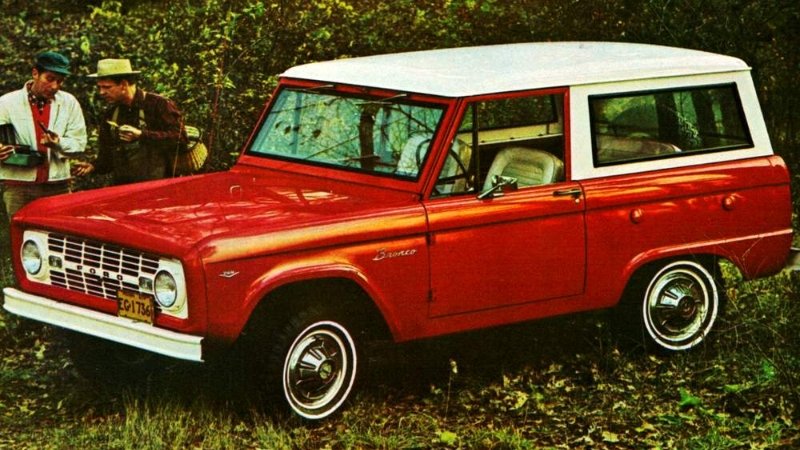
Winning in Baja
The Bronco’s reputation was made in the desert. Bill Stroppe, a well-known race car builder, started preparing Broncos for long-distance off-road racing in 1965, Wikipedia notes, and teamed up with Holman-Moody. The team ran events such as the Mint 400, the Baja 500 and the Mexican 1000, the race now known as the Baja 1000.
In 1969, Stroppe’s team entered six Broncos in the Mexican 1000. Rod Hall and Larry Minor won it outright, beating the motorcycles and dune buggies to the finish, according to Off Road Xtreme. That Bronco later sat in a junkyard in Southern California before being restored for the 2015 NORRA Mexican 1000, where Hall was set to drive it again.
Ford turned the image into a product. In 1971, its dealers sold a Baja Bronco package for $5,566, against $3,665 for a regular V8 Bronco (period figures). Wikipedia says about 650 were sold over four years.
The End of the Small Bronco
For 1978, Ford replaced the original with a much larger Bronco, built as a shortened F-100 four-by-four. The compact, coil-sprung trail truck of 1966 was gone.
Its value has climbed a long way since. In July 2020, Hagerty put the average value of a first-generation Bronco in good condition, its #3 rating, at $40,100. Hagerty noted that values had nearly doubled between 2016 and 2019, and that the best examples with a factory V8 could reach $80,000 or more. Custom builds go well beyond that. In a small sample of sales from late summer 2025, Classic.com records a largely original 1966 half-cab at $41,000, while modified first-generation trucks sold for up to $161,000.