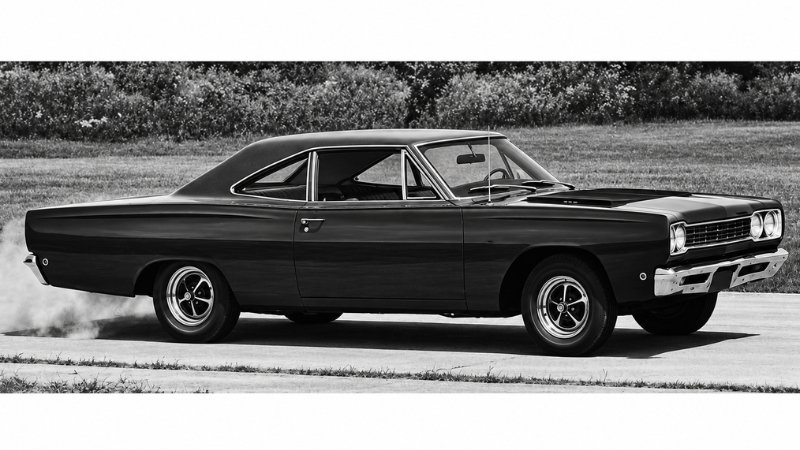
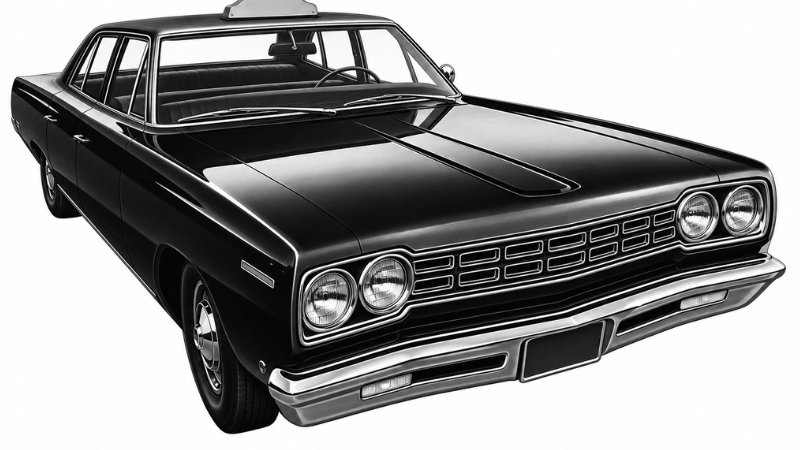
By 1967, a well-equipped muscle car was no longer a cheap car. Plymouth’s answer for 1968 was a plain two-door with rubber floor mats, a big engine and a cartoon bird for a name. Chrysler expected to sell a few thousand. It sold 44,599.
An Idea From a Magazine Writer
The idea came from outside the company. According to Ate Up With Motor, the automotive history site by Aaron Severson, writer Brock Yates sent a memo in 1966 to Bob Anderson, then general manager of Chrysler-Plymouth, proposing what he called an “econo-racer.” Anderson passed it on to product planning, which promised only to consider it for 1968.
Product planning took it further than that. Ate Up With Motor names Joe Sturm as head of the department and Jack Smith and Gordon Cherry among the people who shaped the car. The formula was simple: take the cheapest Belvedere two-door, give it a strong engine and a heavy-duty chassis, and leave out everything that did not make it faster.
The Bird and the Horn
The name came from a cartoon. Ate Up With Motor writes that Cherry thought of the Road Runner while watching cartoons with his children. Smith did not know the cartoons but agreed, and the advertising agency Young & Rubicam had wanted to call the car La Mancha.
Plymouth licensed the Road Runner and Wile E. Coyote characters from Warner Bros. for $50,000, a figure given by both Ate Up With Motor and Curbside Classic. Neither source says whether that was a one-time payment or covered more than one year, and Ate Up With Motor notes that management was not happy about the fees.
The car also got a horn that imitated the bird’s “beep-beep.” Ate Up With Motor says engineering produced the sound by modifying the Belvedere’s standard horn.
What $2,870 Bought
Ate Up With Motor and Old Cars Weekly both give the base price as $2,870 (1968 dollars). Autoevolution lists $2,896 for the post coupe and $3,034 for the hardtop. According to Ate Up With Motor, the Road Runner was $231 cheaper than a base GTO hardtop and $559 cheaper than Plymouth’s own GTX.
The standard engine was a 383-cubic-inch V8 rated at 335 horsepower and 425 lb-ft. It used the cylinder heads and camshaft of the larger 440, along with a high-rise intake and dual exhaust. Old Cars Weekly notes that the rating was only five horsepower above the regular 383, though many believe it made more. A four-speed manual was standard, along with heavy-duty suspension, 11-inch drum brakes and red stripe tires.
The interior was basic. Old Cars Weekly lists a plain bench seat and rubber floor mats. Carpeting and bright trim came with the optional Road Runner Decor Group for $79.20.
Car Life tested a 383 car in 1968. As summarized by Curbside Classic, it ran 0 to 60 mph in 7.3 seconds and the quarter mile in 15.37 seconds at 91.4 mph, with a top speed of 122 mph and 10.8 mpg. The editors blamed the stock tires for the disappointing times. They liked the flexible engine and the handling but complained about the stiff ride and rear drums that locked during the first panic stop.
The Hemi Option
At the top of the order form sat the 426 Street Hemi. It cost $714.30 extra, a quarter of the car’s base price, and was rated at 425 horsepower and 490 lb-ft, according to Old Cars Weekly. Autoevolution adds that Hemi cars came with a Dana 60 rear axle, a Sure-Grip differential and 3.54 gearing, and that their powertrain warranty was cut to one year or 12,000 miles.
Old Cars Weekly gives 1,019 Hemi Road Runners for 1968. Autoevolution uses the same total but breaks it down into 169 hardtops and 840 coupes, which only adds up to 1,009.
A Sales Surprise
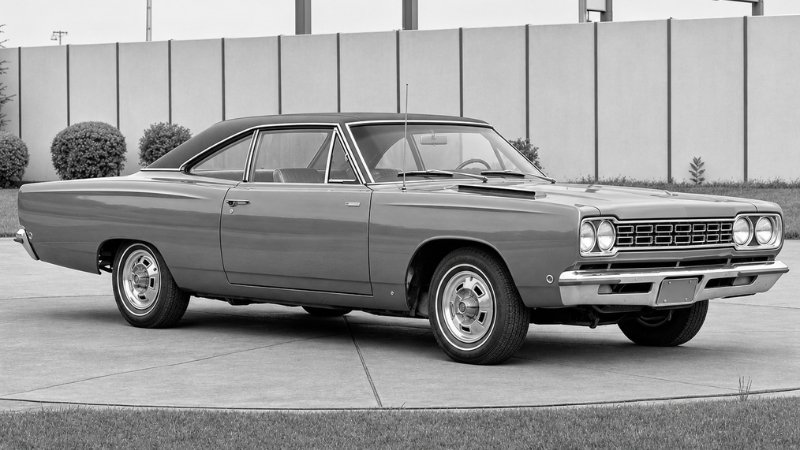
How many Road Runners Chrysler expected to sell depends on the source. Ate Up With Motor says 2,500, while Autoevolution says about 20,000. Both agree on the result: 44,599 for 1968. Old Cars Weekly splits that into 29,240 coupes and 15,359 hardtops, the hardtop arriving midway through the year. Ate Up With Motor notes that the low forecast limited parts supply.
The comparison inside Plymouth’s own showroom was clear. Curbside Classic gives 18,940 GTX sales for the same year.
1969 and 1970
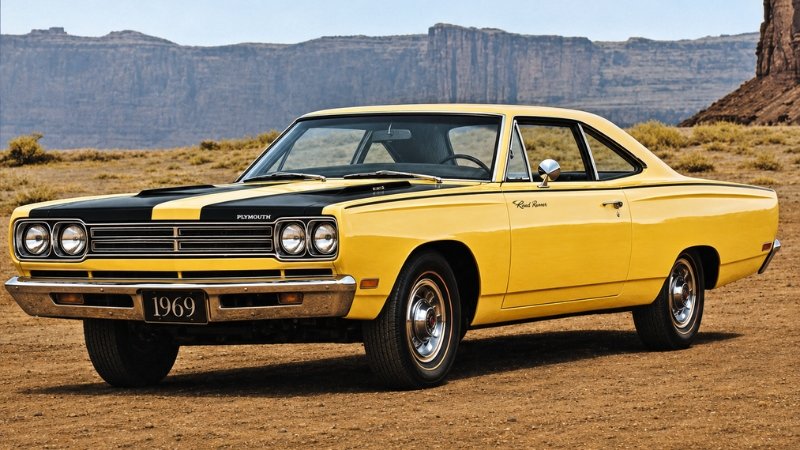
For 1969, the Road Runner added a convertible, and Motor Trend named it Car of the Year, according to Ate Up With Motor. Midway through the year, Plymouth offered a 440 with three two-barrel carburetors, rated at 390 horsepower. Ate Up With Motor describes it as nearly as strong as the Hemi for about a third of the price. Production rose to 82,109, including 2,128 convertibles.
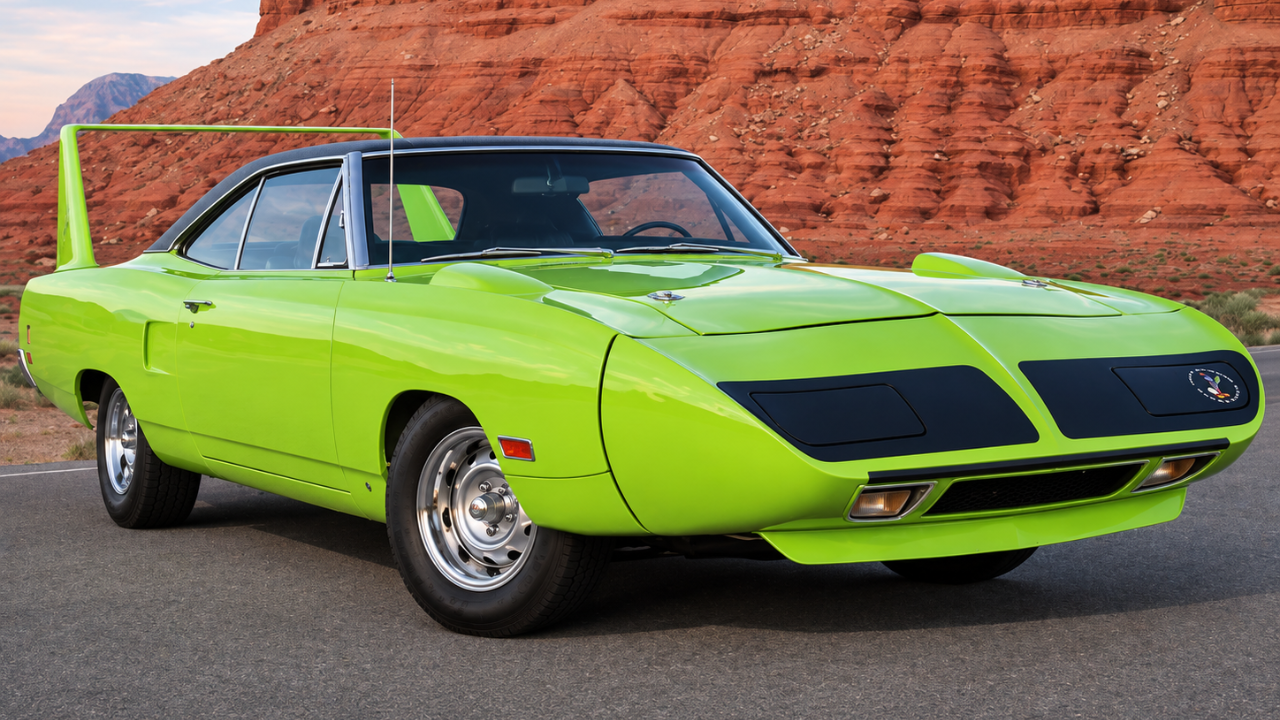
The peak did not last. Production fell to 41,484 for 1970, with 824 convertibles. That year also brought the Superbird, Plymouth’s NASCAR homologation special, built on the Road Runner and sold in a run of 1,920 cars, Ate Up With Motor notes.
The Market Today
The cheap muscle car is no longer cheap. Autoevolution writes that standard 383 cars often exceed $70,000, that numbers-matching Hemi cars average $166,000 at major auctions, and that tribute cars without original drivetrains often sell for more than $100,000. Those are the site’s market estimates, not individual sale results.