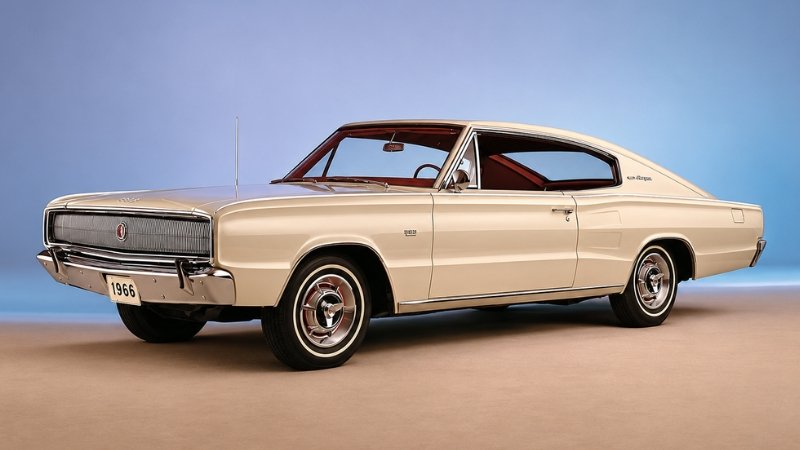
The Dodge Charger made its debut on New Year’s Day 1966, in a commercial during the Rose Bowl broadcast. Twelve years later, the last one left the factory as a near twin of the Chrysler Cordoba, with a 318 V8 as standard. In between, the name stood for a fastback with four bucket seats, one of the best-known shapes of the muscle car era, a winged race car that broke 200 mph, and an orange TV star with a horn that played “Dixie.”
The Leader of the Dodge Rebellion
The first Charger was built quickly, and much of it came from cars Dodge already had. Ate Up With Motor, the automotive history site by Aaron Severson, writes that a 1963 styling study by Carl Cameron was rushed into production as an answer to the Mustang. The Charger shared its front sheet metal, hardtop doors and windshield with the mid-size Coronet, according to Mac’s Motor City Garage. The difference was the long fastback roof.
It went on sale on January 1, 1966, about three months after the rest of the Dodge line. Spokeswoman Pamela Austin introduced it during the Rose Bowl broadcast as the leader of the “Dodge Rebellion,” the division’s marketing theme for 1966 and 1967.
The cabin was the Charger’s other selling point. Mac’s describes four individual bucket seats with a full-length console, and rear seatbacks that folded down to make a flat, carpeted cargo floor about seven and a half feet long. Electric motors opened the doors over the hidden headlights, and a full-width taillight with six lamps set the rear apart from the Coronet.
Every Chrysler V8 was available, up to the 426 Street Hemi with 425 horsepower. How many 1966 Chargers had it depends on the source: Old Cars Weekly gives 468, of which 218 had the TorqueFlite automatic, while Ate Up With Motor says 438.
Sales were modest. Old Cars Weekly counts about 37,300 Chargers for 1966, and Mac’s puts 1967 at around 16,000. Ate Up With Motor points out that Pontiac sold nearly 180,000 GTOs over the same two years. On the track, David Pearson won the 1966 NASCAR Grand National title in a Charger.
The Coke Bottle
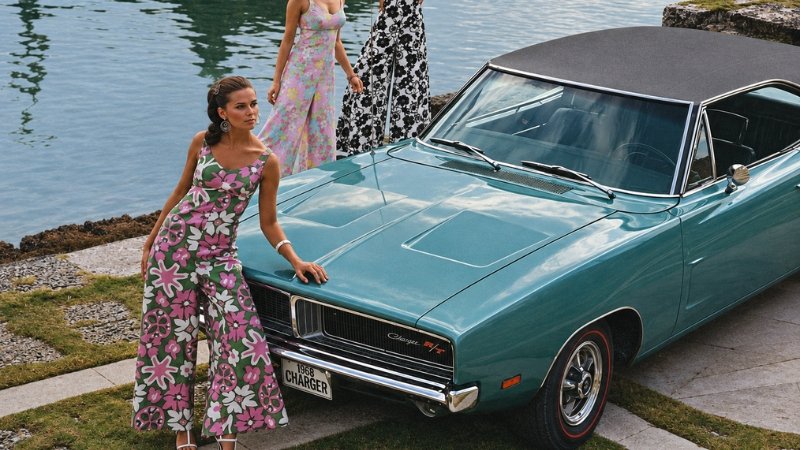
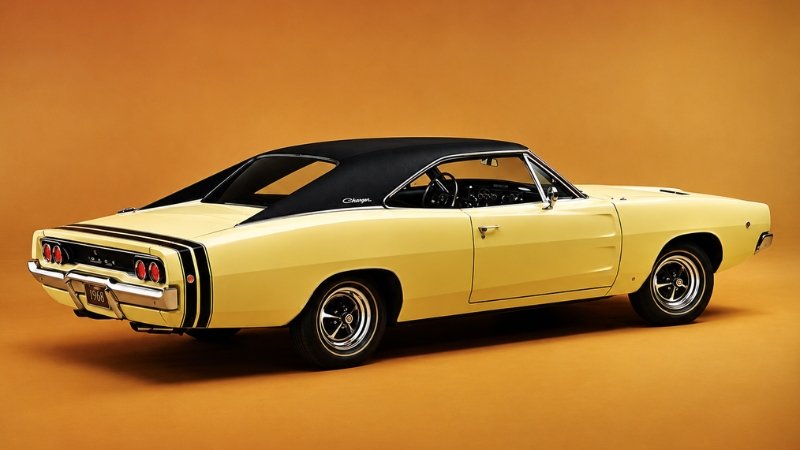
For 1968, Dodge started over. The new Charger had a Coke-bottle body, a flying-buttress roofline with a recessed rear window and a full-width grille that hid the headlights. Ate Up With Motor credits Richard Sias with most of the design work, while Bill Brownlie later said that he had set the major themes.
The new car was also cheaper. A 1968 V8 Charger started at $3,040, $88 less than the year before (period figures), and weighed 175 pounds less. The performance model was the R/T, with a 440 rated at 375 horsepower and TorqueFlite as standard. Ate Up With Motor puts its 0 to 60 mph time at around seven seconds.
The result was a hit. Ate Up With Motor lists 96,108 Chargers for 1968 and almost 90,000 for 1969.
Too Slow for NASCAR
The shape that sold so well was a problem on the superspeedways. The recessed grille and the tunnel around the rear window caused drag and lift, and Ate Up With Motor notes that Dodge won only five of 49 NASCAR races in 1968.
The first fix was the 1969 Charger 500. Creative Industries fitted it with a flush grille borrowed from the Coronet and a plug that filled the rear-window tunnel. It cost $268 more than an R/T. NASCAR required 500 production cars, but Ate Up With Motor says the most commonly cited figure is 392, and that NASCAR overlooked the shortfall.
The Charger 500 was not enough. According to Wikipedia, its racing failure and Richard Petty’s move to Ford pushed Dodge to go further.
The Daytona
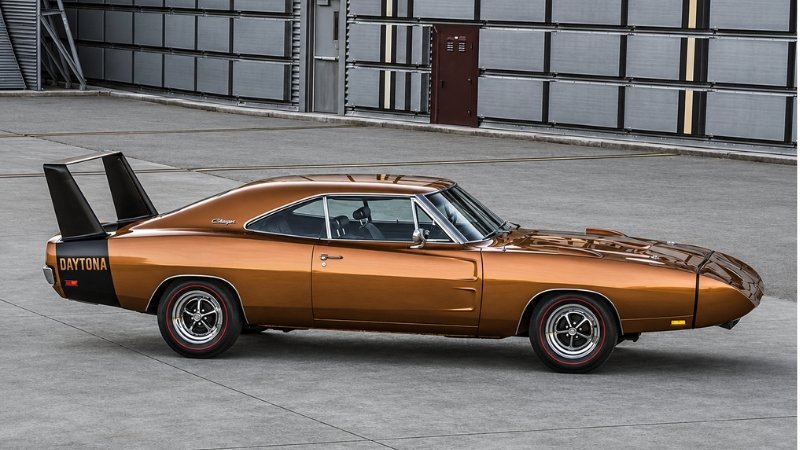
The Charger Daytona was built to win on the fastest tracks. It got a pointed sheet-metal nose cone in place of the grille and a 23-inch-tall stabilizer wing on the rear deck, Wikipedia notes. Ate Up With Motor reports that the wing produced about 800 pounds of downforce at 180 mph, and that a development car reached 243 mph at Chrysler’s test track in Chelsea, Michigan.
The street version started at $3,993, about $400 more than an R/T. A 440 Magnum was standard, and Wikipedia says 70 cars got the 426 Hemi. Production is usually given as 503, though Ate Up With Motor writes that the exact total is uncertain and gives a range of about 501 to 509.
The Daytona’s debut was messy. It won the first Talladega 500 on September 14, 1969, with Richard Brickhouse driving, but about 30 top drivers had boycotted the race, according to Ate Up With Motor. The milestone came the following spring. On March 24, 1970, Buddy Baker became the first NASCAR driver to lap at more than 200 mph, at 200.45 mph in a Chrysler Engineering Daytona at Talladega.
NASCAR then changed the rules. Wikipedia notes that for 1971, aero cars with engines over 305 cubic inches were effectively banned, and by the end of 1970 the winged cars from Dodge, Plymouth, Ford and Mercury were gone from competition.
The General Lee
The 1968 to 1970 Charger got a second career a decade later. The Dukes of Hazzard began filming in Georgia in late 1978, and its star car, the General Lee, was a 1968 or 1969 Charger painted orange, with “01” on the doors, a Confederate battle flag on the roof and a horn that played the first notes of “Dixie,” according to Wikipedia.
The show went through a lot of them. Wikipedia cites estimates of about 325 General Lees from Ben Jones and builders involved with the show, while others say around 255. About 17 of the originals are said to survive. For jumps, crews put 500 to 1,000 pounds of ballast in the trunk to keep the car from nosing over, and the unibody often failed on landing. SlashGear notes that at the time, a 1969 Charger was a 10-year-old used car that was easy and cheap to find.
The car’s flag has been controversial. After the 2015 Charleston church shooting, Warner Bros. halted production of General Lee toy cars, Wikipedia notes. The car known as LEE 1 sold at Barrett-Jackson Scottsdale in 2012 for $110,000, or $121,000 with buyer’s premium, to golfer Bubba Watson, who later removed the flag.
Bigger and Softer
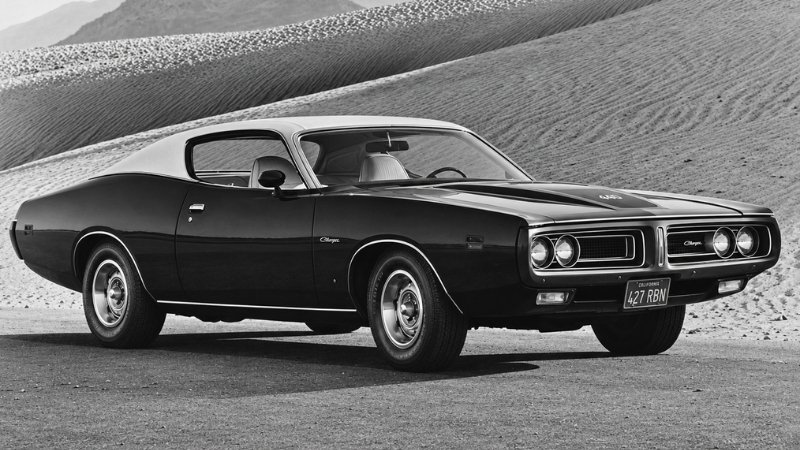
For 1971, the Charger became a wider, slightly shorter car on a 115-inch wheelbase for the two-doors. It also absorbed the Coronet two-door line, along with the Super Bee. Ate Up With Motor counts more than 82,000 Chargers for 1971, including about 5,000 Super Bees and 3,100 R/Ts, both dropped after that year. The 426 Hemi ended in 1971 as well.
Lower outputs and the switch to net ratings cut the numbers that followed. The 440 Six Pack was listed at 330 net horsepower for 1972 before it was dropped, and the top engine became a 440 with 280 net horsepower. But sales stayed strong, and Ate Up With Motor gives nearly 120,000 for 1973.
The Cordoba Clone
For 1975, the Charger became a personal luxury coupe. The Charger SE was almost identical to the new Chrysler Cordoba apart from its grille, taillights, badges and trim, Hagerty notes. The Cordoba had the famous Ricardo Montalban commercials, and it sold far better. Hagerty lists 30,812 Charger SEs for 1975, against 150,105 Cordobas. For 1976, the SE came standard with a 318 V8 rated at 115 horsepower, with the 360 and 400 as options, and sales rose to 42,168.
The sources differ on price. Hagerty lists the 1975 SE from $4,903 and the Cordoba from $5,581. Ate Up With Motor says the Charger was only $169 cheaper than the Cordoba.
For 1976, Dodge also offered a Daytona package for the SE, but it was an appearance package with two-tone paint, a black grille and tape stripes. The Charger was dropped after a short 1978 run, and the Magnum XE took its place, with a blunter nose and fender flares.