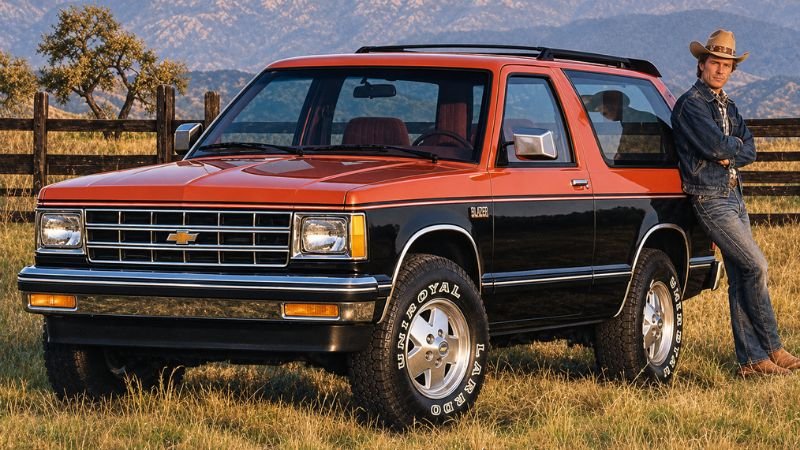
In 1982, Chevrolet took the formula of its big K5 Blazer, cut it down and put it on a compact pickup chassis. The result was smaller, lighter and cheaper to run, and it arrived early enough to claim a place at the start of the compact SUV boom. Over the next two decades, the S-10 Blazer turned into one of the most familiar shapes on American roads. It also became a lesson in what happens when a company gets there first and then stops pushing.
The Baby Blazer
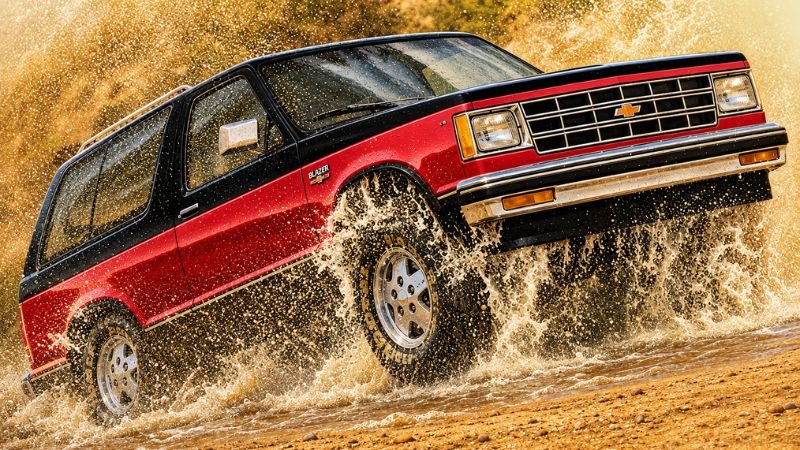
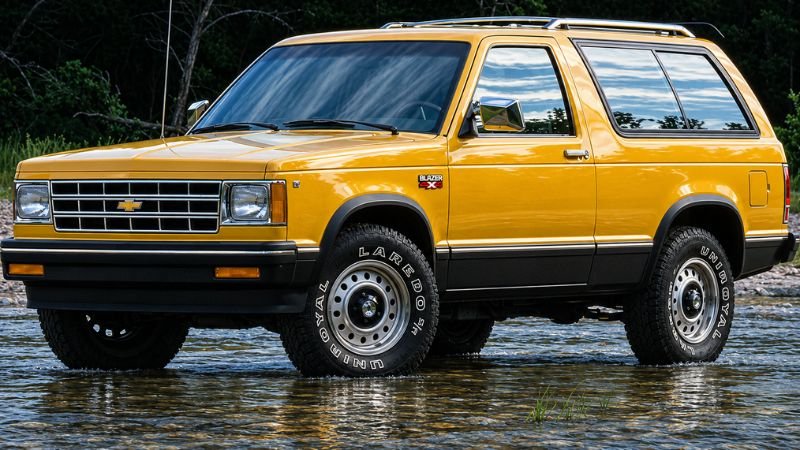
The S-10 Blazer went on sale as a 1983 model, introduced in 1982 alongside its GMC twin, the S-15 Jimmy. It was built on the same platform as the S-10 pickup, which Chevrolet had launched a year earlier. Wikipedia gives the two-door a 100.5-inch wheelbase and notes that it was 14.5 inches shorter and 14.9 inches narrower than the full-size K5 Blazer. A period brochure, summarized by eightiescars.com, says it weighed more than 1,500 pounds less than the big Blazer.
That size gap earned it the nickname “baby Blazer.” Underneath, it was still a body-on-frame truck.
Chevrolet’s slogan that year was “Tough Chevy trucks are taking charge.” The base price for a four-wheel-drive S-10 Blazer was $9,423 (1983 dollars), according to the brochure figures on eightiescars.com. Above the base truck sat two trim levels. The Tahoe added chrome trim, carpeting and a gauge package for $576. The Sport package cost $944 and brought two-tone paint, color-keyed bumpers, reclining front seats, a console and extra sound insulation.
The four-wheel-drive system was called Insta-Trac. It let the driver shift into or out of 4WD High at any speed, though 4WD Low still required a stop.
First, but Not Alone for Long
Who built the first compact SUV depends on how you define the class. Wikipedia’s article on compact SUVs lists the S-10 Blazer as the first of the 1980s wave and describes it as a truck-based body-on-frame design. Paul Niedermeyer of Curbside Classic calls it the first of a new generation of compact four-wheelers that were reasonably comfortable, as opposed to hard-core off-roaders like the Jeep CJ, the International Scout or the early Ford Bronco.
The competition came fast. Jeep’s Cherokee XJ reached showrooms in late 1983 as a 1984 model, with a unibody structure rather than a separate frame, and the same Wikipedia article notes that it is often considered the first compact American four-door SUV. Ford introduced the Bronco II in March 1983, also as a 1984 model. It rode on the Ranger pickup and was nearly a foot shorter than the Blazer, with a 94-inch wheelbase.
Of the three, the Blazer reached the market first. The Cherokee proved to be the more important design.
The Engines
The early engines were not the Blazer’s strongest point. In 1983, the standard engine was a 2.0-liter four with 83 horsepower and a two-barrel carburetor. The optional 2.8-liter V6 made 110 horsepower and added $243 to the price, plus another $247 for the power steering it required. A 2.2-liter Isuzu diesel was also offered, with just 58 horsepower, according to Wikipedia.
Niedermeyer is blunt about the V6. He writes that its Rochester carburetor was hard to adjust and that many 2.8s suffered early rear main seal failures.
From 1985, the base four was GM’s 2.5-liter Iron Duke. The 2.8 V6 got throttle-body fuel injection for 1986. Then, for 1988, came the engine that defined the Blazer for the rest of its life: the 4.3-liter V6, rated at 150 horsepower and raised to 160 the following year. From 1989, Wikipedia notes, the 4.3 was the only engine available.
The Missing Doors
For its first eight years, the S-10 Blazer had two doors. Niedermeyer calls the lack of rear doors its “deadliest deficiency,” and Jalopnik’s Raphael Orlove makes the same point in his summary of Niedermeyer’s history. The Cherokee had offered four doors from the start, and that pushed Japanese rivals like the Isuzu Trooper and Mitsubishi Montero to follow.
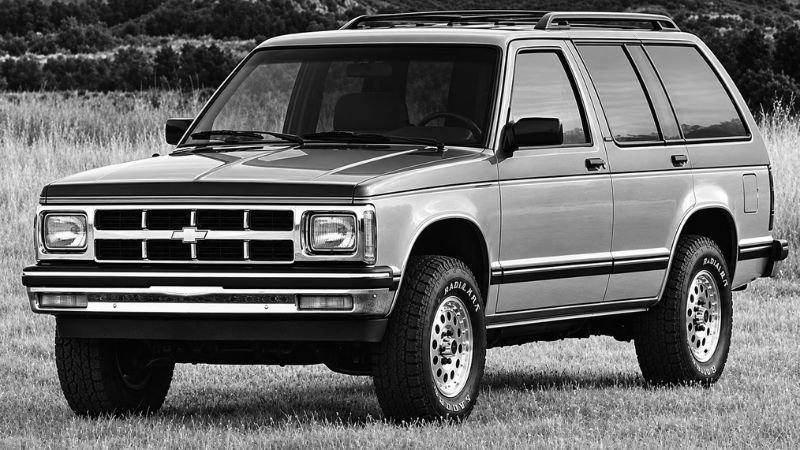
Chevrolet finally introduced a four-door Blazer in March 1990, as a 1991 model. It rode on a 107-inch wheelbase and at first came only with four-wheel drive, according to Wikipedia. Oldsmobile got its own upscale version, the Bravada, with a full-time all-wheel-drive system called Smart-Trak. GMC dropped the S-15 name for 1992 and called its truck simply Jimmy.
The timing was unlucky. By then, as Jalopnik puts it, the Cherokee had dominated the class, and the Ford Explorer arrived for 1991 as well.
The Typhoon
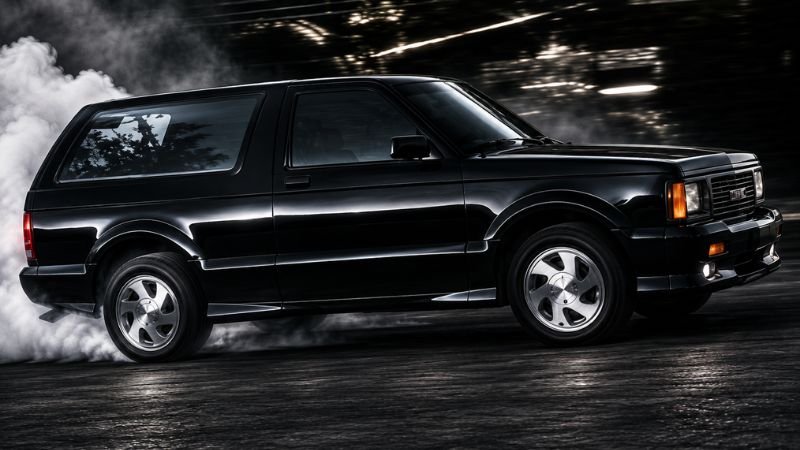
The wildest version of the platform never wore a Chevrolet badge. In 1992 and 1993, GMC sold the Typhoon, a two-door SUV based on the Syclone pickup and related to the Jimmy. It used a turbocharged and intercooled 4.3-liter V6 rated at 280 horsepower and 360 lb-ft, compared with 190 horsepower for the standard Jimmy’s version of the engine.
A four-speed automatic and four-wheel drive with a 35/65 front-to-rear torque split put the power down. Car and Driver measured 0 to 60 mph in 5.3 seconds and the quarter mile in 14.1 seconds at 95 mph, Wikipedia notes. The price was $29,970 (period figure). GMC built 2,497 Typhoons for 1992 and 2,200 for 1993.
The Typhoon is a GMC, not an S-10 Blazer. But it came from the same family, and it showed how much the old platform could take.
The Second Generation
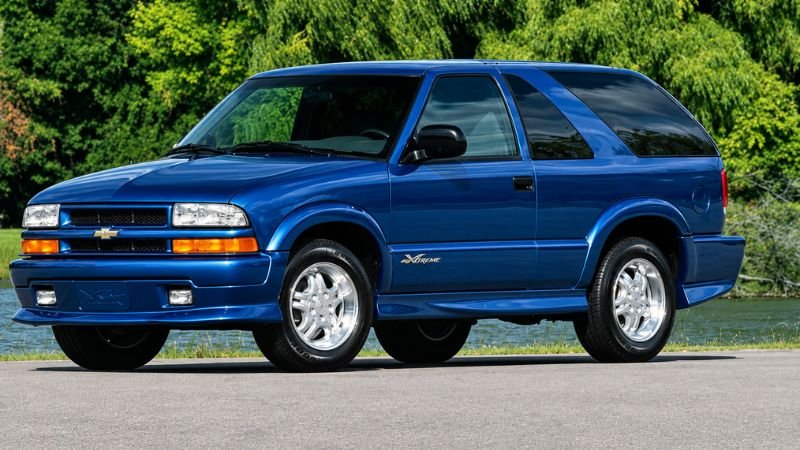
The first redesign came for 1995. Chevrolet dropped the “S-10” from the name and called the compact truck simply Blazer, while the full-size Blazer became the Tahoe. The new model had a Vortec 4.3 with 200 horsepower, and it won both Motor Trend’s Truck of the Year award and the North American Truck of the Year title, according to Wikipedia.
There was a serious weak point. Wikipedia reports that the Blazer of this era received a Poor rating in the Insurance Institute for Highway Safety’s frontal offset crash test.
Retail sales of the four-door in the United States ended in 2004, and fleet sales continued into 2005. In Brazil, the Blazer stayed in production until 2012, according to Wikipedia. Curbside Classic dates the end of the Brazilian four-cylinder model to around 2011.
A Case of Neglect
Niedermeyer lists the S-10 Blazer among GM’s “deadly sins” and files it under sloth. In his view, GM had an early lead in a market that would become enormously profitable for Jeep and Ford, and then left the truck largely as it was. His criticism covers crude ride and handling, mediocre build quality and the long wait for rear doors. He also points out that the first new skin arrived only in 1995, twelve years after launch.
That reputation, plus the large number of trucks built, has kept prices low. Classic.com’s market page for the 1983 to 1994 generation lists an average of $10,426 and recent sales between $5,200 and $15,400. The top figure was a 1989 sold at Mecum’s Indianapolis auction in May 2026. A 1984 Sport offered at the same sale reached $20,000 but did not sell.