In 1960, Chevrolet built more than 250,000 compact cars with an air-cooled six in the back and no radiator.
By 1969, it was building about 6,000 a year. In between, the Corvair created a new kind of American car, the sporty compact with bucket seats, and then watched Ford’s Mustang take that market.
It also became the subject of one of the most famous safety books ever written, and the argument over whether that book was fair has never really ended.
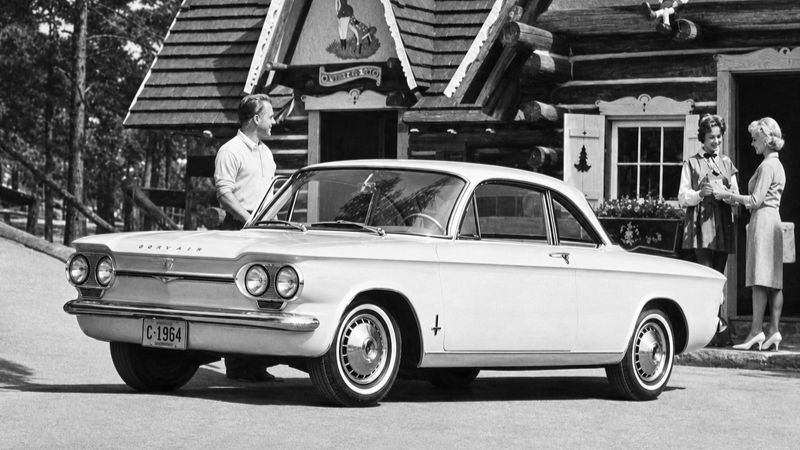
Ed Cole’s Rear Engine
The Corvair was Ed Cole’s car. Ate Up With Motor, the automotive history site by Aaron Severson, writes that Chevrolet’s chief engineer, later its general manager, had been interested in rear engines since at least 1941. To keep the project quiet in the 1950s, he disguised it as a development program for GM’s Australian brand, Holden.
In 1955, research director Maurice Olley compared three layouts and chose rear engine and rear drive for packaging, weight, traction and light steering. That decision forced everything else. The car needed a unibody, which was new for Chevrolet, independent rear suspension and an air-cooled engine, because water cooling was judged impractical in the back.
The engine was a horizontally opposed six, which Ate Up With Motor notes had little precedent in passenger cars. It displaced 140 cubic inches and was rated at 80 gross horsepower and 125 lb-ft. The rear suspension used swing axles, with the half-shafts acting as control arms.
The Corvair arrived for 1960. It was named Motor Trend’s Car of the Year, and Time put Cole and the car on its cover, according to Wikipedia. The Corvair Society’s production figures list 250,007 cars for the first year.
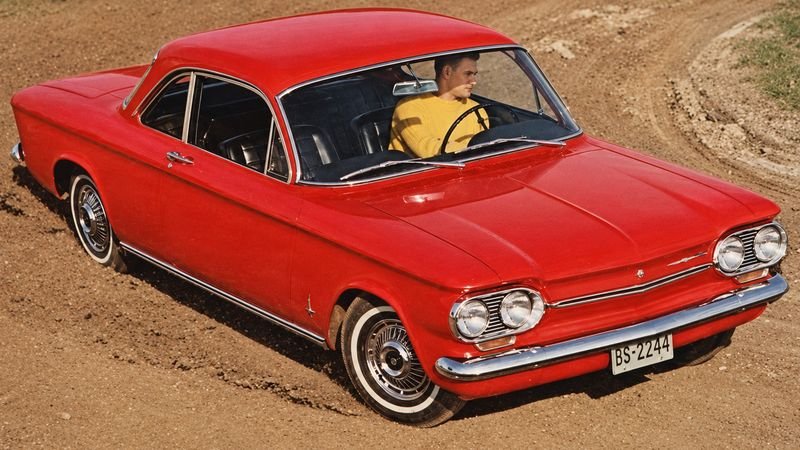
The Monza Changes the Plan
The Corvair was meant to be an economy car, and Ford’s Falcon, a conventional front-engine compact, was its main rival. Chevrolet even ordered its own conventional compact, the Chevy II, in December 1959, Ate Up With Motor notes.
The Corvair found another purpose. Late in the 1960 model year, Chevrolet added the Monza, a better-trimmed coupe with bucket seats. The Corvair Society lists 11,926 Monza coupes for 1960, built in about five months. In 1961, it became the best-selling Corvair by nearly two to one, and total production rose to 329,632, followed by 328,500 for 1962.
The line grew quickly. A Lakewood station wagon came for 1961 but was dropped in April 1962. More successful were the forward-control models modeled on the Volkswagen Type 2: the Greenbrier van, the Corvan and the Rampside and Loadside pickups. The Corvair Society lists 10,787 Rampsides for 1961 alone.
Turbo Power
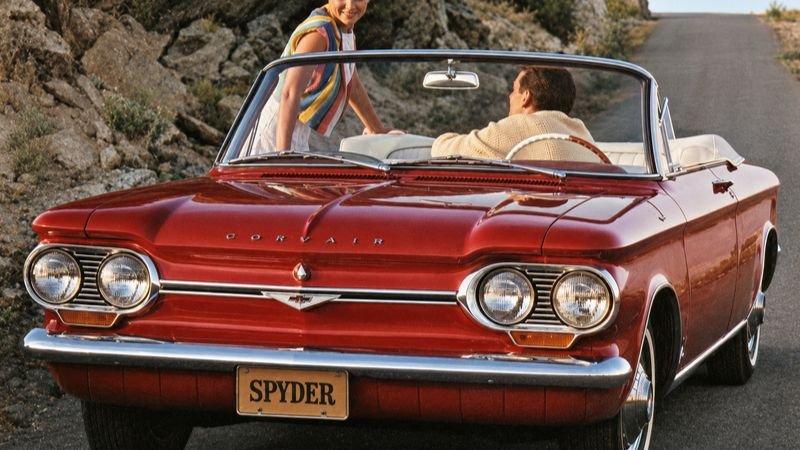
In April 1962, Chevrolet added the Monza Spyder. Its turbocharged flat-six was rated at 150 gross horsepower and 210 lb-ft. Ate Up With Motor calls it the first turbocharged gasoline production car. The Spyder option cost $317.45, before the required four-speed, heavy-duty suspension and metallic brake linings. A four-speed car could reach 60 mph in about 11 seconds.
For 1964, the engine grew to 164 cubic inches, with 95 horsepower in base form and 110 as an option. Chevrolet also changed the rear suspension, softening the coil springs and adding a transverse leaf spring, according to Ate Up With Motor and Wikipedia. Production dropped to 207,114 that year.
The Mustang Arrives
Ate Up With Motor argues that the Monza’s success helped inspire the Ford Mustang and the other pony cars that followed. The Mustang went on sale in April 1964, and Wikipedia notes that it broke sales records and hurt the Corvair. It offered V8 engines up to 271 horsepower, while the most powerful Corvair had 180.
Chevrolet answered with a new Corvair for 1965. Ate Up With Motor credits the styling to Henry Haga’s Chevrolet studio under chief stylist Ron Hill. Every body style was a pillarless hardtop. The rear suspension was now a fully independent design based on the 1963 Corvette Sting Ray’s, developed by Frank Winchell and Zora Arkus-Duntov. The new top model, the Corsa, had a 140-horsepower engine with four carburetors, or a turbo with 180 horsepower and 265 lb-ft.
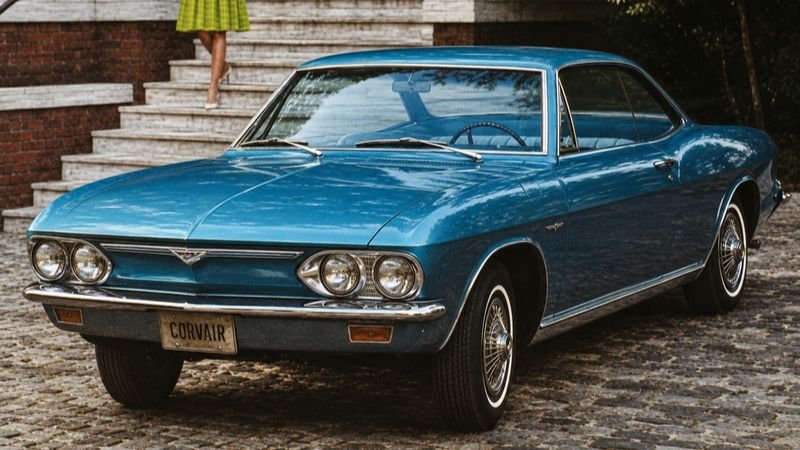
The car sold well again, with 237,056 for 1965 according to the Corvair Society. But Ate Up With Motor notes that the Mustang outsold it by nearly two to one. In April 1965, GM froze Corvair engineering development, limiting future changes to what regulations required.
Ralph Nader and the Safety Question
In the fall of 1965, Ralph Nader’s chapter “The Corvair Story” appeared in The Nation, just as the 1966 models went on sale. It became the first chapter of his book Unsafe at Any Speed. His central argument concerned the 1960 to 1963 cars and their swing-axle rear suspension, which he said could tuck the outside rear wheel under in hard cornering.
The criticism had a background. Ate Up With Motor writes that the early cars carried nearly 64 percent of their weight on the rear wheels, and that Chevrolet recommended tire pressures of 15 psi front and 26 psi rear, which cut the front tires’ load capacity by 40 percent. By 1965, more than 100 civil lawsuits had been filed against GM over the Corvair’s safety.
What followed damaged GM more than the book did. GM hired a private detective to follow Nader. In March 1966, GM president James Roche admitted the surveillance and apologized before Senator Abe Ribicoff’s traffic safety subcommittee, according to Ate Up With Motor. The episode helped lead to the National Traffic and Motor Vehicle Safety Act later that year.
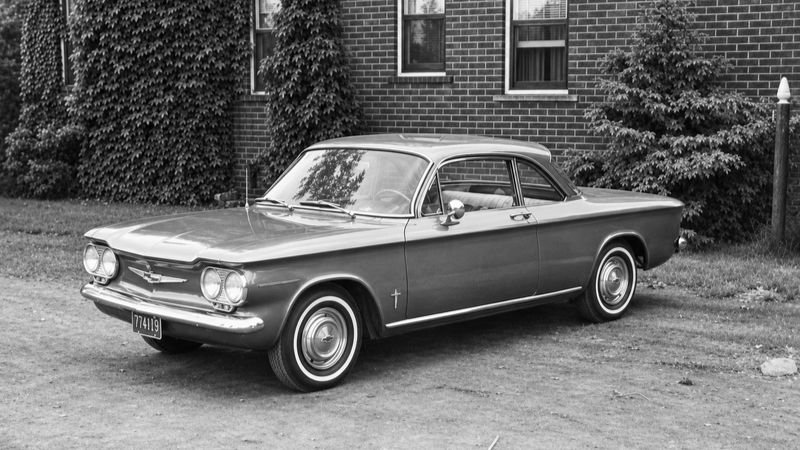
In July 1972, the National Highway Traffic Safety Administration published its own evaluation of the 1960 to 1963 Corvair. Testing was carried out with the Texas Transportation Institute at Texas A&M. The report found that the car’s handling did not result in an abnormal potential for loss of control or rollover, and that it compared favorably with the contemporary cars it was tested against.
That did not settle the matter. Ate Up With Motor points out that the cars were tested only at maximum load, which changed the rear suspension geometry. In the author’s view, the report is accurate for a heavily loaded car but does not fully clear the early Corvair driven with one person aboard. Wikipedia notes that John DeLorean later wrote that Nader’s criticisms were valid, while the car’s defenders point to the NHTSA findings. The question is still disputed.
The Slow End
Sales collapsed after 1965. The Corvair Society lists 103,743 cars for 1966, 27,253 for 1967 and 15,399 for 1968. Ate Up With Motor notes that the Camaro, new for 1967, was now competing from inside Chevrolet. A third-generation design and a later rear-engine concept were both shelved.
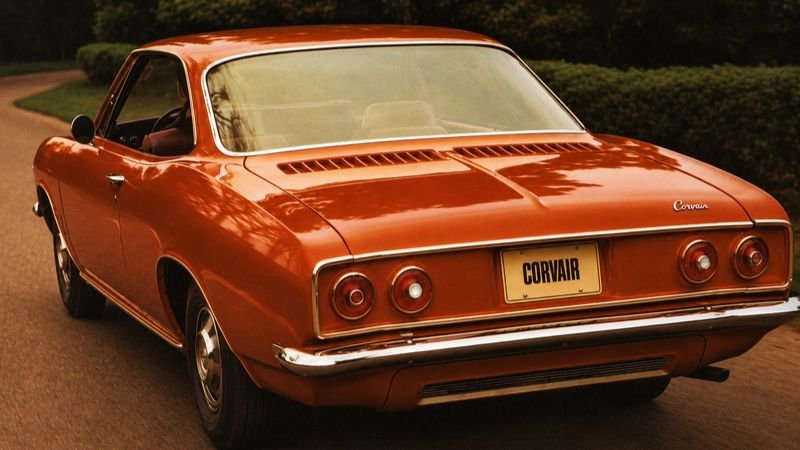
The last Corvair left the factory on May 14, 1969. Production totals differ slightly by source. Ate Up With Motor calls it the 1,786,243rd Corvair built in the United States, while the Corvair Society lists 1,789,384 U.S. cars, including kits for assembly abroad, and 1,839,439 worldwide.
Hagerty sums up the legacy in one line: Chevrolet never again took design risks like that.