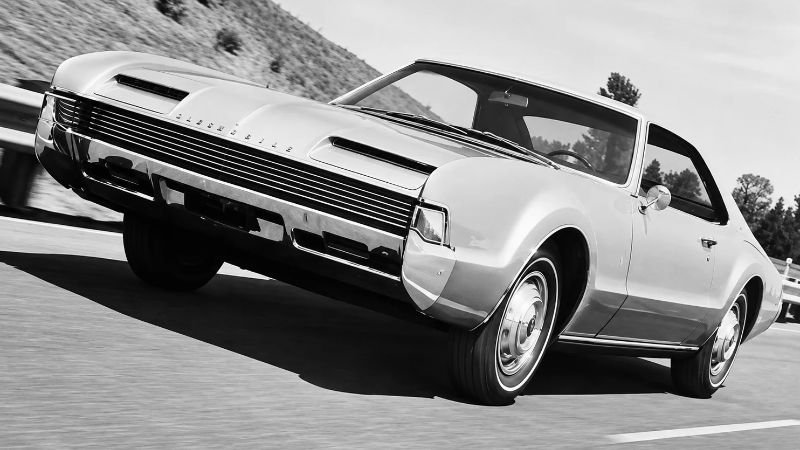
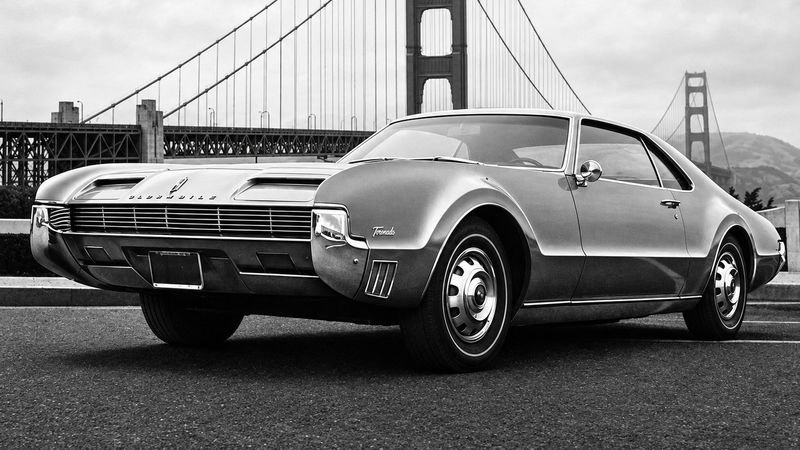
The last American production car with front-wheel drive before 1966 was the Cord 812, and it went out of production in August 1937. For almost three decades after that, Detroit built every car the same way, with the engine in front and the power going to the rear. Then Oldsmobile put a 425-cubic-inch V8 over the front wheels of a big personal luxury coupe and called it Toronado.
The Toronado in Numbers
- Built: 1966 to 1992, 798,057 cars over 27 model years, according to production figures published by the owners’ group Toronado and Aurora Chapter
- Best year: 1973, with 55,921 cars
- Worst year: 1992, with 6,436 cars
- First engine: 425-cubic-inch Rocket V8, 385 gross horsepower
- Last engine: 3.8-liter Buick V6, 170 horsepower
- Price at launch: $4,617 (1966 dollars)
1957 to 1965: Nine Years of Development
The project started in 1957, when Andrew K. Watt, head of Oldsmobile’s advanced engineering, began work on front-wheel drive, according to Ate Up With Motor, Aaron Severson’s automotive history site. Assistant chief engineer John Beltz became its champion and demonstrated a prototype at the GM Proving Grounds early in 1964. The body came from a concept by stylist David North, which Severson describes as a “flame red car.” Bunkie Knudsen chose the name.
The technical heart of the car was the Unitized Power Package. Instead of turning the engine sideways, Oldsmobile kept the V8 lengthwise and moved the transmission alongside it. A two-inch-wide Morse Hy-Vo chain connected the torque converter to the gearbox, which was a Turbo Hydra-Matic 400 turned around and offset to the left. A planetary differential sat at the front.
There was a curious footnote. Ate Up With Motor notes that the layout appears to have been covered by a 1962 Ford patent by engineer Fred Hooven, and that it is not known whether this caused any licensing issue.
1966: Car of the Year
The Toronado was the first American front-wheel-drive production car in almost 30 years. Motor Trend named it Car of the Year, Car Life gave it an award for engineering excellence, and Wikipedia notes it finished third in the European Car of the Year voting.
It was big and fast for its size. Ate Up With Motor gives a weight of about 4,650 pounds with air conditioning, a 0 to 60 mph time of eight to nine seconds and a top speed of about 130 mph. Testers praised its stability and wet-weather traction and found almost no torque steer. They were less happy with the brakes, which faded and locked the rear wheels. Front discs became optional for 1967 and standard for 1970.
Oldsmobile also took it racing in a small way. Toronados won the stock class at Pikes Peak in 1966 and took the first three places in 1968, according to Ate Up With Motor.
The sales were the disappointment. Oldsmobile wanted 50,000 a year and built 40,963 for 1966. Ford’s Thunderbird outsold it by more than 28,000, and Buick’s rear-drive Riviera sold more as well.
1967 to 1970: Cadillac Takes the Idea
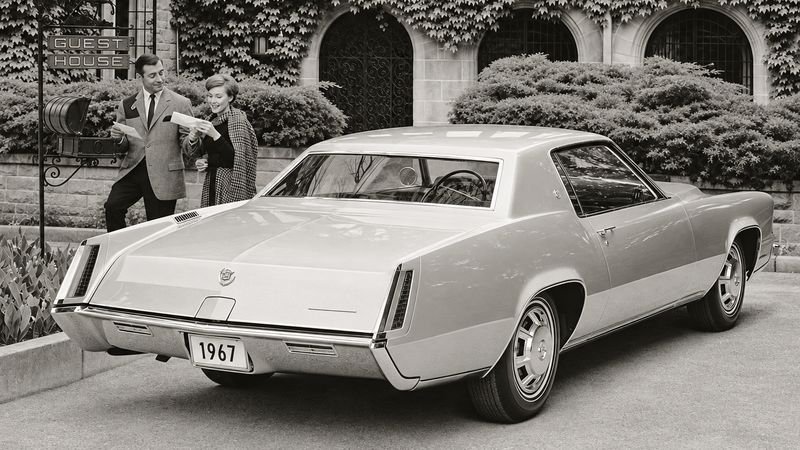
For 1967, Cadillac introduced its own front-wheel-drive Eldorado on the same E-body, and Toronado production fell to 21,790. By 1970, the Eldorado was selling better than the Oldsmobile despite costing almost $2,000 more, Ate Up With Motor notes.
The engine grew to 455 cubic inches for 1968. A W34 option that year added 400 gross horsepower and 500 lb-ft, but Ate Up With Motor counts fewer than 150 buyers. Oldsmobile chief engineer Harold Metzel later said the Toronado was never profitable.
1971 to 1978: Bigger, Then Hit by the Oil Crisis
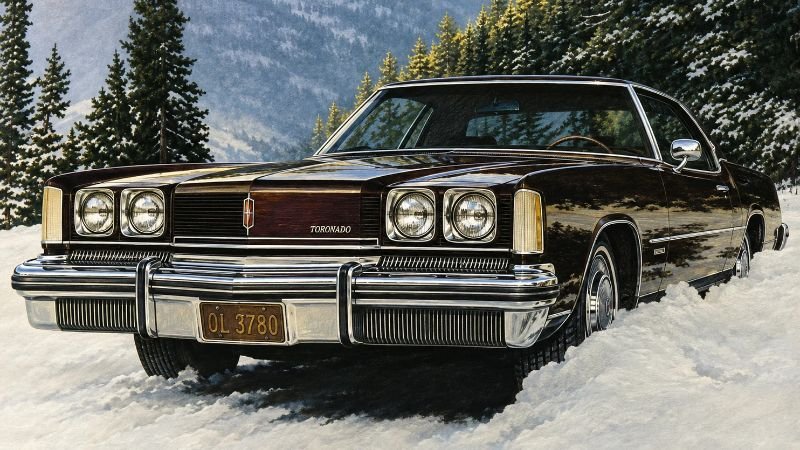
The second-generation Toronado of 1971 was 219.9 inches long, larger than before, and its 455 was rated at 275 net horsepower. Sales grew to 48,900 for 1972 and peaked at 55,921 for 1973.
It also carried an early safety technology. Ate Up With Motor writes that GM offered its Air Cushion Restraint System, an early airbag, from late 1973. About 11,000 cars were fitted with it before GM dropped the option in 1976.
Then the oil embargo hit. Toronado sales fell by half for 1974. The Unitized Power Package found another use in the meantime: it powered the GMC Motorhome, built from 1973 to 1978, of which fewer than 13,000 were made.
1979 to 1985: The Best Seller
For 1979, GM shrank the E-body. The Toronado lost almost half a ton and dropped to a 114-inch wheelbase, and sales more than doubled, to 50,056. Ate Up With Motor calls this its most successful generation, with almost 300,000 built over seven years. The diesel V8 offered from 1979 was the weak point, with a poor service record.
1986 to 1992: Too Small, Too Late
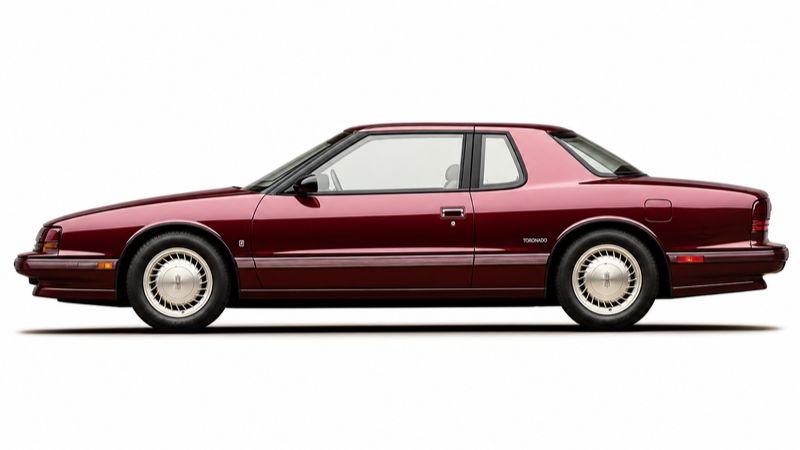
The 1986 Toronado was a different car. It was 187.5 inches long, used a transverse Buick V6 instead of the Unitized Power Package and cost about 16 percent more than before, Wikipedia notes. Gas had become cheap again, buyers wanted bigger cars, and sales fell to 15,924.
Oldsmobile tried to fix it. The Trofeo arrived as an upscale version, and Wikipedia notes that the 1989 Trofeo offered the Visual Information Center, an early dashboard touchscreen for climate, radio and trip computer. For 1990, the car grew by about a foot at the rear and got a standard driver’s airbag. None of it worked. Mac’s Motor City Garage counts 5,197 Trofeos and 1,239 base Toronados for 1992, and the last one left the Lansing plant on May 28, 1992.
What Came After
The Toronado’s place in the lineup went to the Aurora sedan, which arrived for 1995. By then, as Mac’s Motor City Garage points out, the Toronado itself had long since switched to the transverse front-drive powertrain used across GM’s lineup.
Oldsmobile did not last much longer. GM announced in 2000 that it would end the brand, and on April 29, 2004, the last Oldsmobile, a dark cherry red Alero sedan, was built in Lansing, History.com notes. Founded in 1897, the brand had built more than 35 million cars.