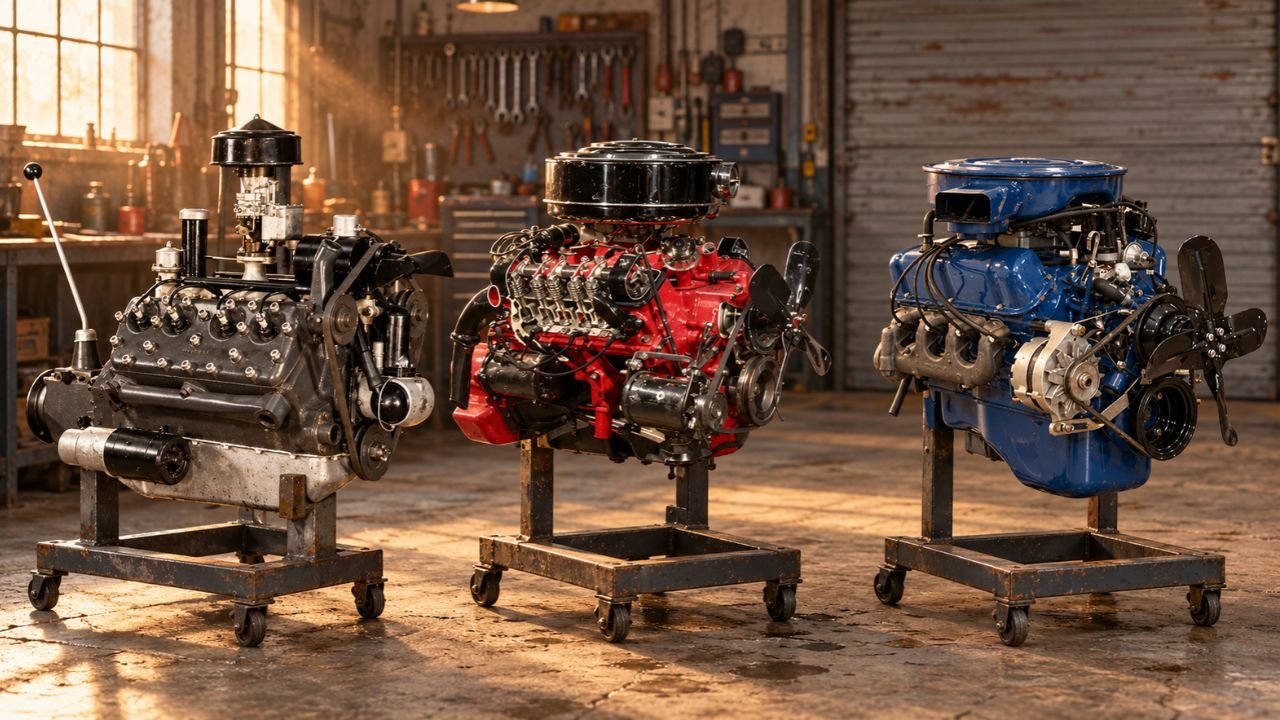
Plenty of Ford engines were meant to be temporary. A bridge to the next design. A truck motor that would do until something better came along. A layout engineers already considered old on the day the tooling went in. Some of them never got the memo.
The ten below earned their place in one of three ways: a production run that went on for decades, a service life that embarrassed newer designs, or an afterlife on other continents and in crate engine catalogs. A few managed all three. They appear in the order they were born.
The 10 Ford Engines That Refused To Die
1. Flathead V8 (1932-1953)
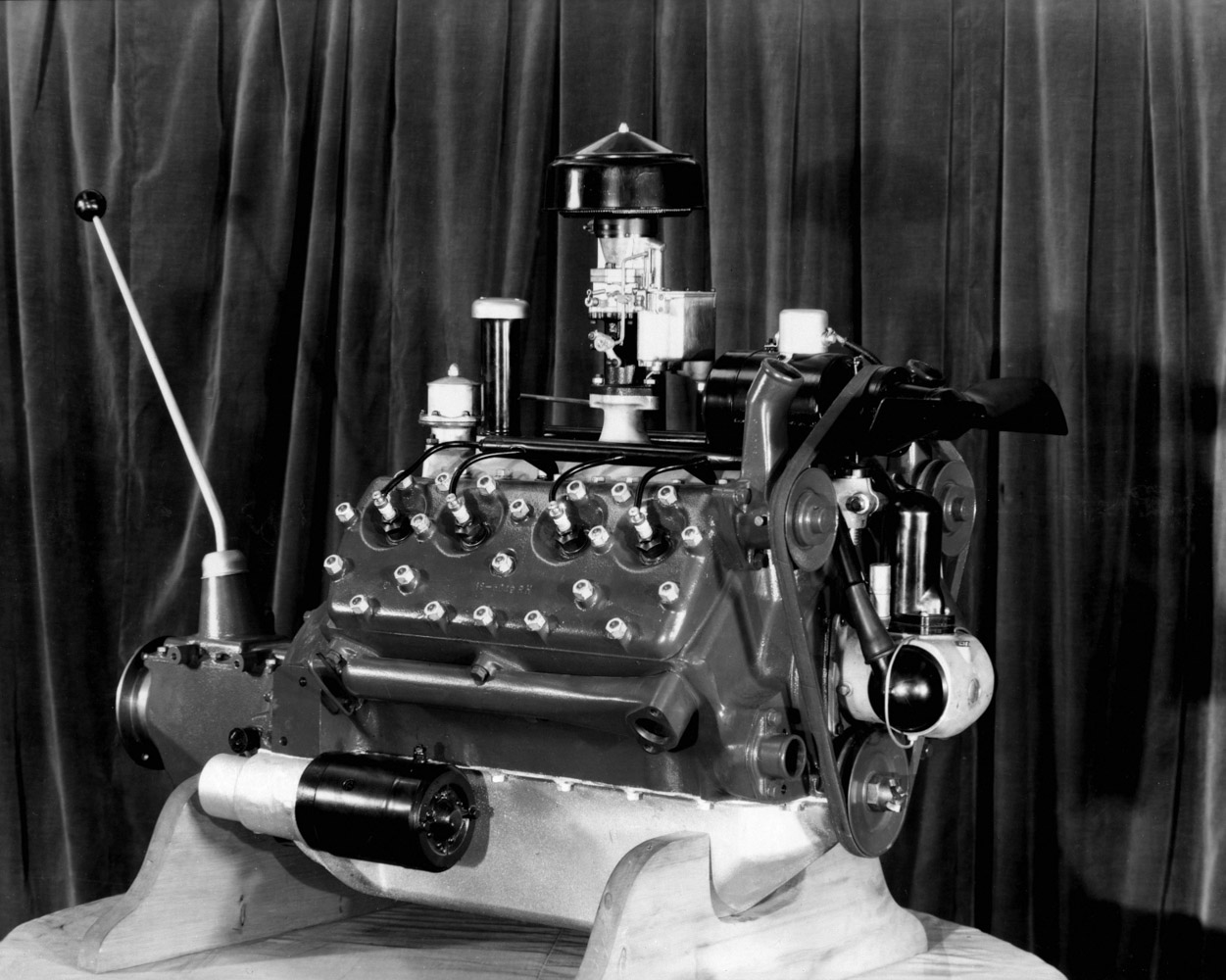
In 1932 Ford did something nobody in the low-price field had done. It cast the crankcase and all eight cylinders as a single piece of iron, which brought a V8 down to Model B money. The first version displaced 221 cubic inches, ran a 5.5:1 compression ratio and made 65 horsepower. The V8 car cost just $10 more than the four-cylinder Model B (1932 dollars), and Ford sold 298,647 of them that first year against 133,539 Bs.
The design grew to 239 cubic inches, then to 255 in Mercury trim, and a 337-cubic-inch truck version went into the F7 and F8 from 1948. Replaceable bearing shells, standard from 1937, made it cheap to rebuild, one big reason hot rodders adopted it. American production stopped in 1953. By then, according to The Henry Ford, more than 25 million Ford cars and trucks had left the line with a V8.
That was only the domestic ending. Ford’s French operation had put the small flathead in the Vedette, Simca bought the Poissy plant in 1954 and kept building the 2.35-liter engine as the Aquilon, and Simca do Brasil started production near São Paulo in 1959. The Brazilian engine later gained overhead valves and hemispherical chambers as the Emi-Sul, and that descendant stayed in production until 1969, by then under Chrysler ownership. Thirty-seven years from Dearborn to São Bernardo do Campo.
2. Y-Block 292/312 (1954-1964 in the US)

At home, the Y-block had a short and complicated life. It arrived for 1954 as a 239, making Ford the first low-priced American brand with an overhead-valve V8, and its deep block skirts gave it the shape behind the name. For 1955 came the 272 and 292, the latter rated at 193 horsepower and 280 lb-ft in the Thunderbird and Mercury. The 312 followed for 1956, and for 1957 Ford bolted a Paxton supercharger to it, the peak of Y-block performance.
The FE took over the big cars from 1958, and the Windsor finished the job in 1962. Trucks kept the 292 through 1964. In the United States, that was a ten-year run.
The long life happened in South America, and it belongs mostly to the 292, not the 312. Ford Argentina began installing it in the 1961 F-100. In 1971 the Argentine engine got new cylinder heads, the so-called Fase II, and it powered the locally built Fairlane until that car ended in 1982. Trucks kept it longer still. EngineLabs puts the last pickup application in 1986, Curbside Classic only says the late 1980s, so the exact final year remains open. In Brazil, the 272 stayed in F-Series trucks until 1977.
3. FE 390 (1961-1976)

The FE family ran from 1958 to 1976 and stretched from 332 to 428 cubic inches in production cars. The 390 joined in 1961 with a 4.05-inch bore and a 3.78-inch stroke, and it became the most common FE of all: base engine in full-size Fords, offered with two-barrel, four-barrel or Tri-Power induction, and a staple in trucks.
It had a performance career too. In the 1967 Mustang the 390 GT option was rated at 320 horsepower, and the engine stayed on the pony car’s option list through 1969.
What kept it alive was the truck business. Ford dropped the 390 from its cars after 1971 but kept building it for pickups through 1976, when the FE line closed. Even the name is still argued over. Ford-Edsel is the most common reading, while some enthusiast sources insist it simply meant Ford Engine.
4. Windsor 289/302 (1962-2001)

The small block started modestly, as a 221 in the 1962 Fairlane and Mercury Meteor. A 260 followed in the middle of that model year, and the 289 arrived for 1963, just in time to become the Mustang’s V8. For 1968 Ford lengthened the stroke to 3.0 inches and created the 302, the displacement that would carry the engine for three decades. The Trans-Am Boss 302 paired the Windsor block with Cleveland-style heads.
The Windsor name is a quirk in itself. Early engines actually came from Ford’s Cleveland, Ohio, plant, and the label stuck to tell the older design apart from the later 335-series Cleveland V8.
Retirement came slowly. The Modular V8 replaced it in the 1991 Lincoln Town Car, the Mustang switched to the 4.6 for 1996, and the F-Series dropped the 302 in 1996 or 1997, depending on the source. The 2001 Explorer was the last North American vehicle to get one. A final build-ahead in December 2000 supplied Ford Australia, which used the 5.0 in the Falcon and Fairlane until 2002. Ford’s performance parts division kept selling it as a crate engine after that.
5. 351 Windsor (1969-1997)

For 1969 Ford gave the Windsor a taller deck, room for a 3.50-inch stroke on the same 4.00-inch bore, and the 351W was born. It used the same bellhousing and motor mounts as the 302, which made it an easy swap and a favorite foundation for builders. Enthusiasts generally rate the 1969 to 1974 blocks as the strongest, and the “Clevor,” 351 Cleveland heads on a 351W block, became a hot rod staple.
Its long career ran mostly through wagons, big sedans and trucks. It stayed carbureted in the Crown Victoria wagon, Grand Marquis and police car through 1991, which made those the last American-brand cars sold with a carburetor. Trucks moved to fuel injection in 1988 and roller cams in 1994, and the SVT F-150 Lightning of 1993 to 1995 used a 240-horsepower version. The 5.8 left the F-Series after 1997, replaced by the 5.4-liter Modular.
6. 385-Series 460 (1968-1997)

Ford named the 385 family after the 3.85-inch stroke of its biggest member. Built at the Lima, Ohio, engine plant, the 460 started at the top of the range: it debuted in the 1968 Lincoln Continental with a gross rating of 365 horsepower and 485 lb-ft. Its sibling, the 429, launched the same year in the Thunderbird and went on to the Cobra Jet, Super Cobra Jet and Boss 429.
The car career ended with downsizing. After the 1978 model year, no full-size Ford, Mercury or Lincoln carried the 460. Then the second life began: F-250 and F-350 pickups, E-Series vans, motorhome chassis, marine and industrial use. Fuel injection arrived in 1988, and the 7.5 kept pulling trailers until the Triton V10 replaced it. Most sources end its truck run with 1997, while Wikipedia lists production into 1998. Stroked 514 and 572 crate versions followed from Ford’s performance division.
7. 4.6 Modular 2V (1991-2011 in the Panther cars)

The Modular V8 debuted in the 1991 Lincoln Town Car, replacing the 5.0 Windsor with a single overhead cam per bank and two valves per cylinder. The redesigned Crown Victoria got it for 1992, and so did the Police Interceptor, which Ford sold until 2011. A long-wheelbase Crown Vic, built from 2002 mainly for taxi fleets, put the same engine into cab service.
The numbers were never dramatic. A 2009 Police Interceptor kept by the Ontario Provincial Police museum is listed at 250 horsepower at 5,000 rpm and 297 lb-ft, backed by a 4R70W four-speed automatic. Mileage built the reputation. Fleet cars often passed 200,000 miles and some taxis went beyond 500,000, according to the listing for a 2011 Interceptor that Hagerty auctioned in November 2025. Those are seller and fleet figures, not factory data.
Retired cruisers typically went to auction and found second careers as cabs and delivery cars, the OPP museum notes. St. Thomas Assembly in Ontario built more than 1.5 million Crown Victorias, Police Interceptors included, and the last one left the line on September 15, 2011. The Panther platform went with it.
8. 6.8 Triton V10 (1997-2019/2021)

Take the Modular V8, add two cylinders, and you have the engine Ford needed to replace the 460. The V10 appeared in the E-Series for 1997 and in the new Super Duty for 1999, making 275 horsepower and 425 lb-ft at launch. A three-valve version arrived for 2005, rated at 362 horsepower and 457 lb-ft in the F-Series.
Pickup buyers lost it after 2010. Commercial customers didn’t. It kept going in chassis cabs, F-650 and F-750 trucks, E-Series cutaways and the F-53 motorhome chassis, and Blue Bird offered a propane version in its Vision school bus. Diesel Hub dates the last commercial application to 2019, other outlets to 2021. Ford Authority reports that the Godzilla V8 took its place in the E-Series for the 2021 model year.
Ford never published a total. Consumer Guide estimated between 750,000 and one million units, which, if correct, would make it the most common V10 ever built. Treat that as an educated guess.
9. 7.3 Power Stroke Diesel (1994-2003)

Navistar built it in Indianapolis as the T444E, and Ford sold it as the Power Stroke from the middle of the 1994 model year. It kept the 4.11 by 4.18-inch bore and stroke of the IDI diesel it replaced, and little else. HEUI injection and a wastegated turbo made it a different animal. Launch output was 210 horsepower and 425 lb-ft. By 2003 it was rated at 275 horsepower and 525 lb-ft.
It went into F-250 and F-350 pickups, Super Duty chassis cabs, the Excursion, E-Series vans, F-650 and F-750 trucks and International bus chassis. Nearly two million were built before the 6.0 took over during the 2003 model year. Why it was retired depends on whom you ask: Wikipedia cites California noise rules, other sources name emissions standards. Remanufacturer Diesel Experts quotes a B50 life rating of 350,000 miles, calls that conservative, and notes that 7.3 trucks still hold their value well.
10. 7.3 Godzilla Gas V8 (2020-present)

This one is the outlier. Godzilla is too young to have outlived anything. What refused to die is the idea behind it. After the 460 left the trucks, Ford’s big gas engines went overhead cam. For the 2020 Super Duty, Ford came back with 445 cubic inches, a cast-iron block, aluminum heads, a single camshaft in the block and two valves per cylinder. The 1968 recipe, built with modern tooling. It is the largest gasoline engine Ford has offered since the 460.
Pickup trim makes 430 horsepower and 475 lb-ft. Chassis cabs get 350 horsepower, and the E-Series stripped chassis, which it joined for 2021, runs a 300-horsepower tune. A short-stroke 6.8-liter version replaced the 6.2 in the 2023 Super Duty.
Hot rodders noticed fast. Ford Performance listed it as a crate engine in 2020 at $8,150, a price that later rose to $9,175. According to The Drive, it is 4.5 inches narrower than a Coyote. The Megazilla, with stronger internals, was revealed at the PRI show ahead of a 2023 launch and raised crate output to 615 horsepower and 640 lb-ft. Whether Godzilla lasts as long as the others is a question for 2050.
Built to Be Fixed
None of these engines were exotic. Most were iron, simple, made in enormous numbers and sized for work rather than glory. That combination is what keeps an engine alive long after its plant closes. There are always cores, always parts, and always somebody who knows how to put one back together. The flathead proved it first. Godzilla is betting on it now.